I prefer to grill on charcoal and wood, gas grilling is not my style! That’s just how I roll! Nothing beats grilling with natural fuel sources for that added outdoor flavor and control than wood or charcoal. I have grilled on wood, charcoal, propane, natural gas, and electricity, both at home and in professional kitchens, and I always come back to natural ingredients for my fuel sources. Once you learn the tricks to getting your fire and coals right, it is like riding a bike, you never forget!
With the summer heat in full swing in just about all parts of the country, it is the perfect time for outdoor grilling, and a great change up from the typical meat, chicken, beef, pork, or fish and seafood is …..Vegetables! Yes, we are grilling vegetables today, because they taste great, are great for you, and dog gone it, I like em!
I am sharing with you three recipes, two grilled vegetables, and a sour cream sauce for dipping too! First up is my Grilled Eggplant recipe, followed by some Grilled Okra, and finishing out with my Sour Cream Sauce, which is a perfect addition to the grilled vegetables. Enjoy!

Grilled Vegetable Plate with Sour Cream Sauce
Grilled Eggplant
Slice the eggplant into 1-inch rounds and lightly salt each side, set them on a paper towel covered pan and allow to rest at room temperature for at least 1 hour.
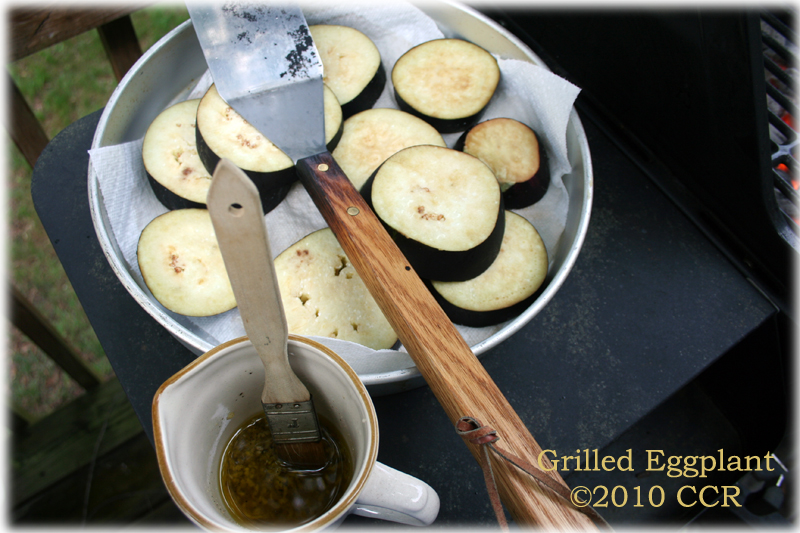
Eggplant ready for the grill
Garlic infused olive oil – Prepare a small portion of garlic infused olive oil, typically, for every ¼ cup of olive oil infuse with two cloves of minced garlic. Then add a pinch of salt and white pepper, stirring well to incorporate.
When the coals are ready, brush the top side of the eggplant sliced rounds with some of the garlic olive oil, and grill 6 inches from the coals for about 5 minutes or until nicely browned. Just before turning, brush the raw side of the eggplant with more garlic olive oil and then flip, then grill another 5 minutes or until nicely browned. Reserve to a clean dish and keep warm until service. Serve with the sour cream sauce.
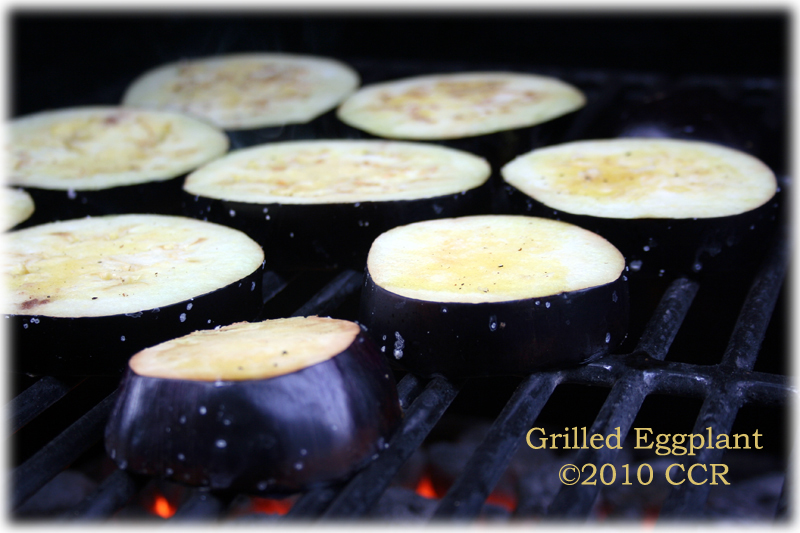
Eggplant on the grill, first side down

Eggplant on the grill, second side down
Grilled Okra
With about 2 pounds of fresh okra, you will need about 30 bamboo skewers. Soak the wooden skewers in cold water for at least 1 hour. Then gently line up about four to five okra pieces per skewer.
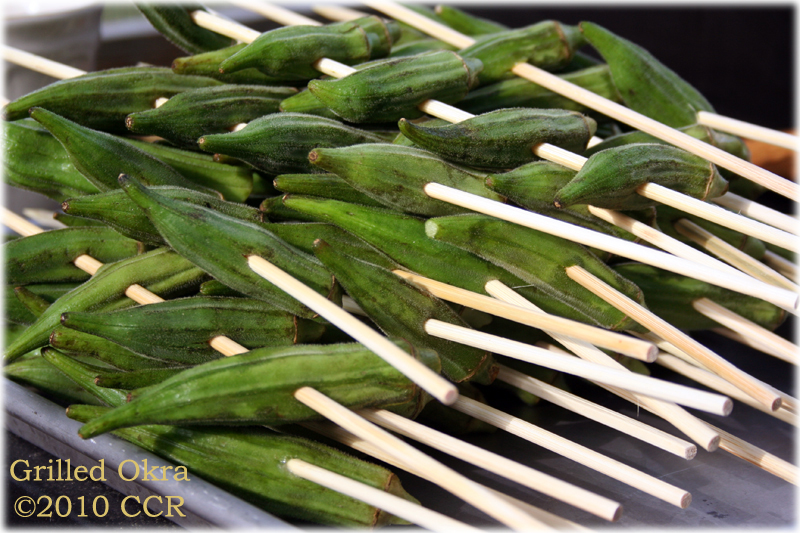
Okra on the skewers
When ready to grill, lightly brush all sides of the okra with the remaining garlic infused olive oil and grill 6 inches from the coals for about 5 minutes per side, or until nicely browned on all sides. Reserve to a clean dish and keep warm until service. Serve with the sour cream sauce.
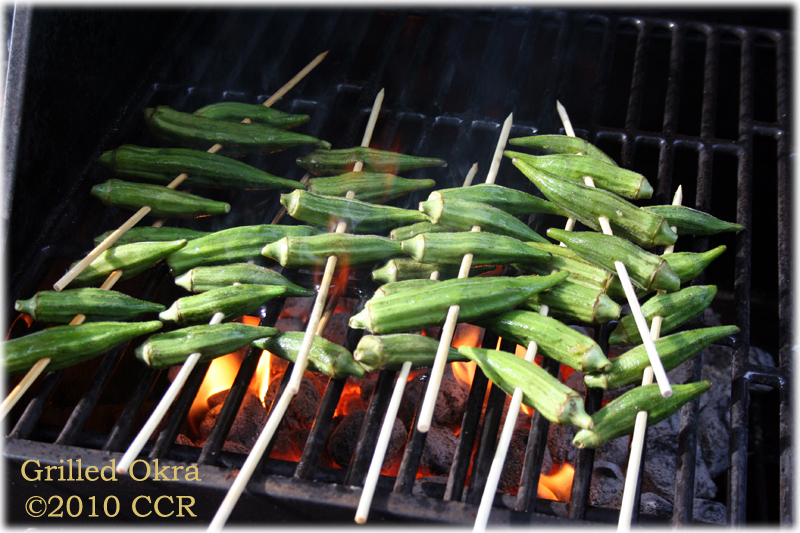
Grilling Okra on the coals
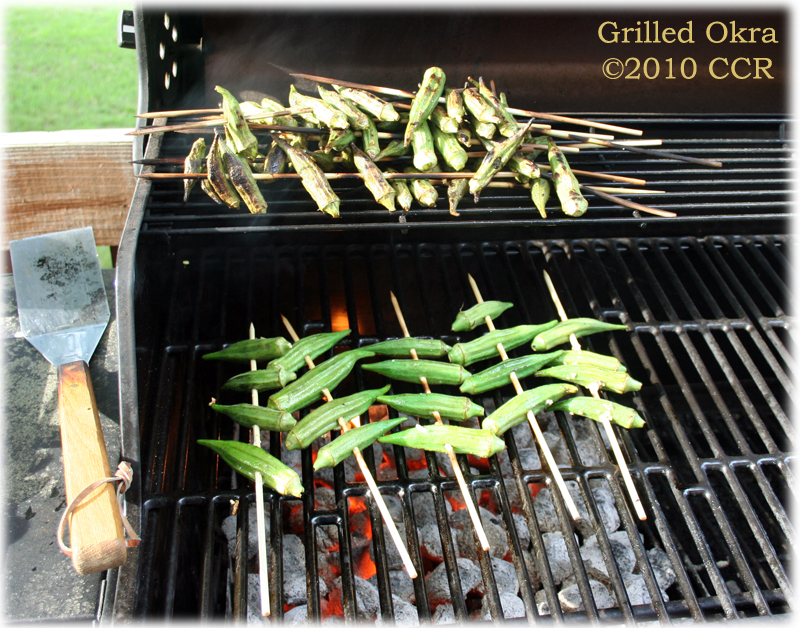
Grilling Okra on the coals, a few done at the top
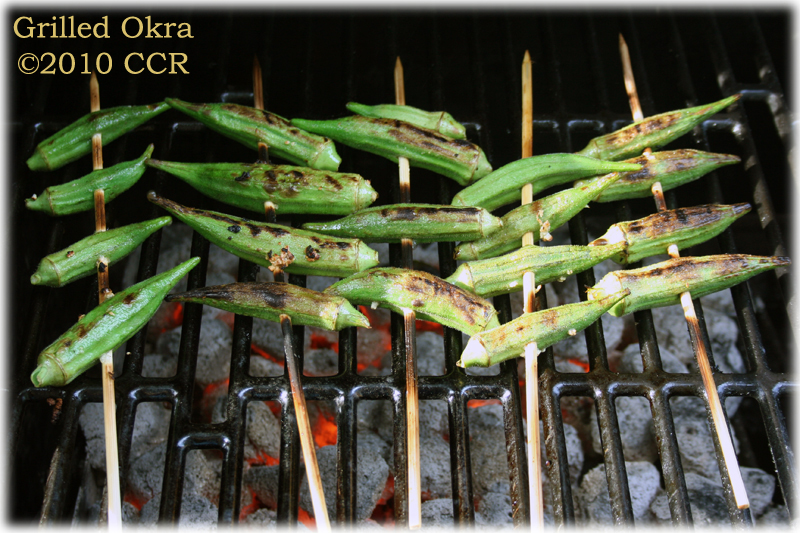
Okra on the coals, a closer view
Sour Cream Sauce
The slight hint of garlic in this sauce is just right for the combination of vegetables, along with a touch of rice wine vinegar this adds a mild tanginess that melds well with the sour cream and Dijon mustard.
| Ingredients |
| ½ |
Cup |
Olive oil |
| 2 |
Tbsp |
Rice wine vinegar |
| 1 |
Tsp |
Dijon mustard |
| 2 |
Tsp |
Lemon juice, fresh squeezed |
| 2 |
Tbsp |
Sour cream |
| 1 |
Clove |
Garlic, minced |
| Pinch |
Sugar |
| To taste |
Salt and white pepper |
| Procedure Steps |
| 1. |
Combine the oil and vinegar and whisk well to smooth. |
| 2. |
Add Dijon mustard, lemon juice, sour cream, garlic, and sugar and blend well to a smooth even consistency. |
| 3. |
Season the sauce to taste with the salt and white pepper. |

Grilled Okra ready to serve
Bon appetit!
CCR
=:~)
©2010 CCR
Tags: Barbecue · Recipes · Vegetarian · Whole Foods Cuisine
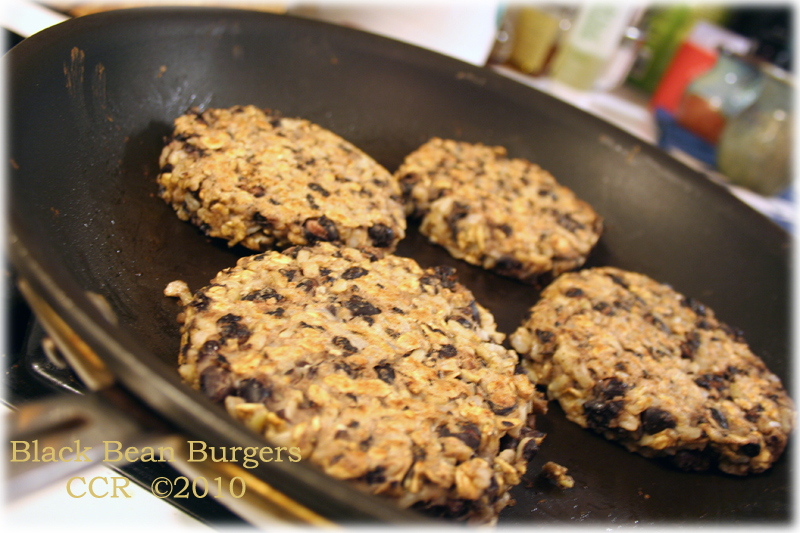
These meatless meal burgers, served with fresh sliced tomatoes, lettuce, and fresh salsa, with a sprinkling of Gorgonzola cheese. Alternatively, add some guacamole and sour cream for that southwest jolt of flavor in these easy and quick to make burgers. Moreover, we did not miss the meat in these burgers, the beans, brown rice with oatmeal give you enough filling fiber rich ingredients, and it was hard to tell there was no animal protein in them at all.
| Ingredients |
| 2 |
Cups |
Black beans, cooked, rinsed and drained |
| 1 |
Cup |
Brown rice, cooked |
| ½ |
Cup |
Oatmeal, dry |
| 2 |
Lg |
Eggs, lightly beaten |
| ½ |
Tsp |
Garlic salt |
| ½ |
Tsp |
Fresh cracked black pepper |
| ½ |
Tbsp |
Olive oil |
| 4 |
Each |
Whole wheat hamburger buns |
| 4 |
Leaves |
Lettuce leaves, washed and dried |
| 1 |
Cup |
Salsa |
| ½ |
Cup |
Gorgonzola cheese, crumbled |
|
| Procedure Steps |
| 1. |
Place black beans in a medium bowl and slightly mash some of them with a fork or potato masher, leaving about half of them whole. |
| 2. |
Stir in the rice, oatmeal, eggs, garlic salt, and fresh black pepper. Mix well to incorporate. Then divide the mixture into 4 even portions, shaping into 1-inch thick patties. |
| 3. |
Heat olive oil in a large non-stick pan over medium heat and brown the patties for 4 to 5 minutes on each side, or until browned and heated through. |
| 4. |
Place each patty on the bottom portion of each bun, then top each with ¼ cup of the salsa, 2 tablespoons of the Gorgonzola cheese, and add lettuce and tomato to the top half of the bun. |
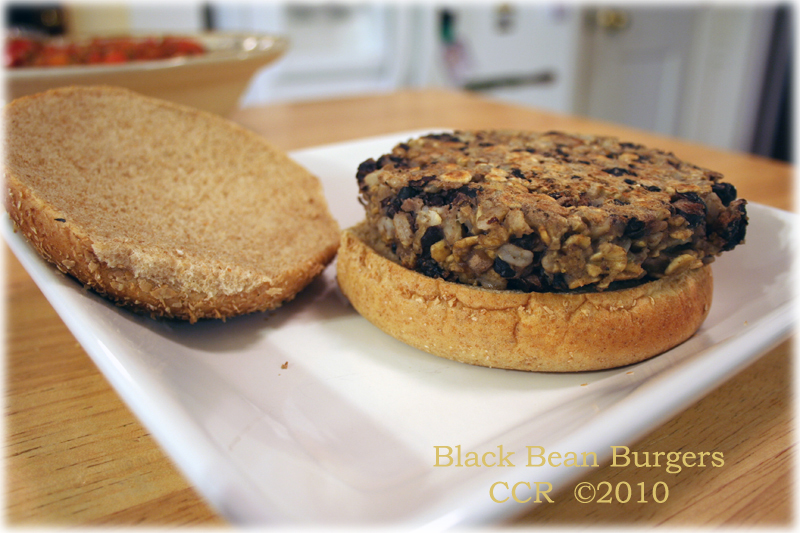
Patty on the bun
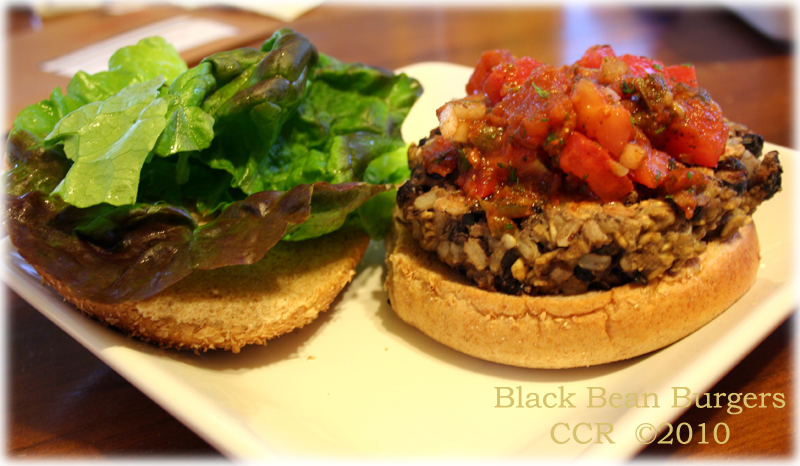
Patty on the bun, with lettuce and salsa
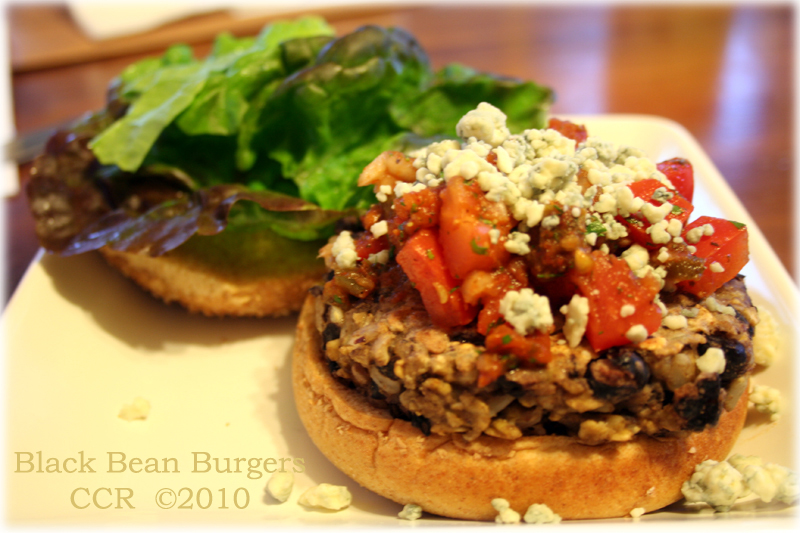
Patty on the bun, with lettuce, salsa and Gorgonzola cheese
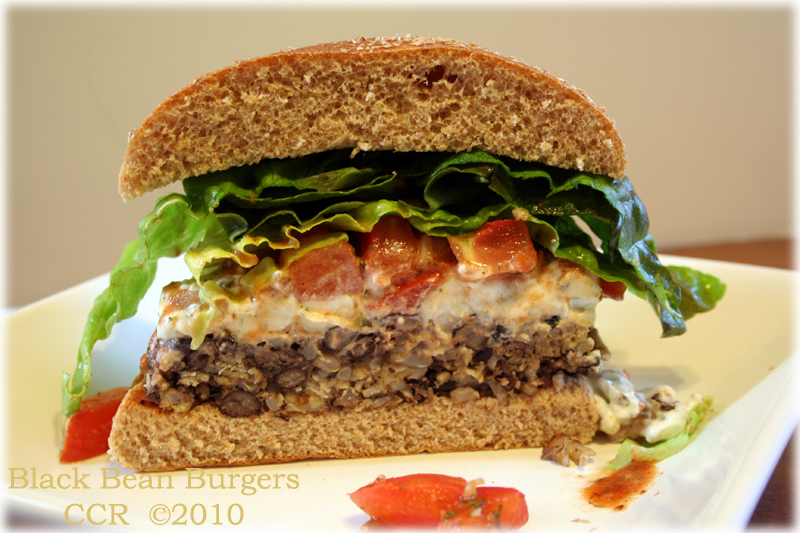
Patty on the bun, with sour cream, salsa, and lettuce, then cut in half
Tags: Recipes · Vegetarian · Weight Watchers · Whole Foods Cuisine
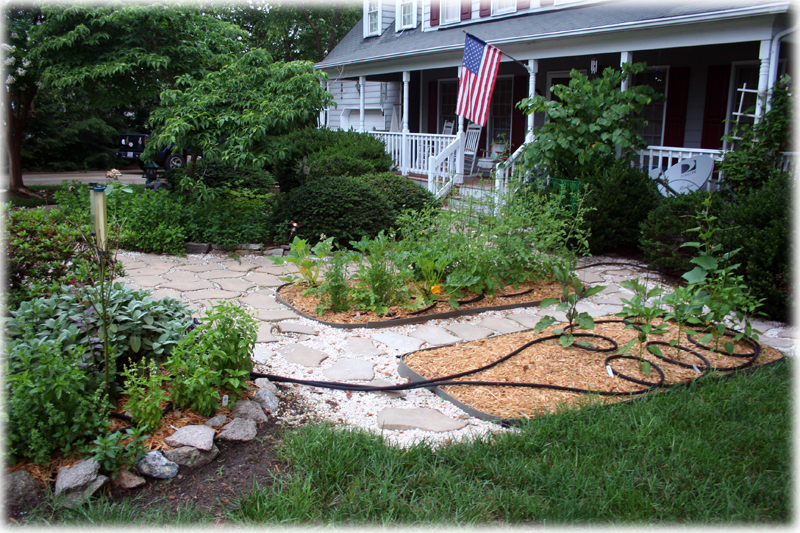 Our “Eat the View” organic garden has expanded more than triple in size from last year and there are plans to continue the expansion with every season. With efforts to bridge the gap to a more sustainable future and with the growing patches of vegetables come the need for more organic materials such as mulch, soil, and nutrients. The expansion of the “homesteading” on our near half acre of land has necessitated the development of a new composting project. This discourse focuses on efforts at capturing some of the beneficial opportunities that Mother Nature intended.
Like most folks, you are probably tossing good nutrients down the kitchen drain or into the garbage can. Moreover, if you keep a tidy yard, maybe you are like many folks who bag up their fallen leaves, yard debris, and grass clippings and put them out on the curb nicely packaged and ready for the weekly trip to the landfill. Some folks do not pack that well for a trip to the beach, but they sure do pack their grass clippings all nice and tidy for the trip to someone else’s back yard, as long as it’s not in my back yard, right!
NIMBY, or “not in my back yard” as the saying goes, buy hey, at least this yard stuff is safe material and not hazardous…oh, but did that trusty neighbor next door recently treat his yard and garden with herbicides, pesticides, or fertilizers….Diazinon, Malathion, Roundup, Weed-B-Gon, Turf Builder, or Winterizer ring a bell?
Consider this…with a little work, you can reap the benefits and rewards that Mother Nature intended.
- Thirty percent of all kitchen household waste is organic material that can be recycled, yet most folks just drop it into the garbage pail or disposal.
- In developing countries the average household generates up to 75% of its total waste in organic material, there are many missed opportunities here also.
Inside the Kitchen
 It is one of the paradoxes of modern culture that materials can change their value in an instant; similar in the fashion as one person’s trash becomes another person’s treasure. The food on your plate, so desirable when first appreciated with a robust appetite, having already traversed an incredibly long chain of energy, resources, and processes expended in the production and preparation for the table; in one instant turns into garbage by the contented palate. What a moment ago was a chef’s delight, now is a nasty platter, at best a “leftover”, or consigned to the doggy bag, or transferred to a storage container and pushed to the back of the refrigerator and left for mold growth experiments that would make anyone cringe, and most likely and ultimately thrown out with the garbage or disposal.
This remarkable value transformation occurring entirely in the human mind creates the perception that what was once a full plate of nourishment, is now a has-been by-product collection of trash, totally void of any redeeming qualities. Alas, in reality, the plate scraps, discarded vegetables, and debris resulting from the toil and hours of determined preparation of the meal are still full of energy and life, complete with the same nutrients needed for life as when first served from the kitchen. Moreover, these discarded scraps offer a far more generous variety of elements necessary for producing more food than can be found in any sack of fertilizer.
Things that were common during the agricultural age became passé or lost in the industrial and information age. Lately, more with emphasis on the production, packing, shipping, and preparation of food sources, with little importance on completing the cycle with decomposition back into the earth from which it started. Foodstuff scraps are for the most part disconnected from the complete natural lifecycle. This system relegates organic kitchen material to enclosed plastic bags, mixed with refuse, plastics, paper, dust, and other non-recyclable items, shipped off to a landfill, and then covered with earth, buried forever in a tomb, never to be utilized again, or at least for many decades. There are so many similar life cycle disconnects in our “modern-age” that it seems plausible to suggest there must be a better way! On a bright spot, some communities are now organizing food waste recycling efforts, for example, the city of Oxford; UK has successfully implemented a food waste collection system since December 2009.
Reduce, Reuse, Recycle
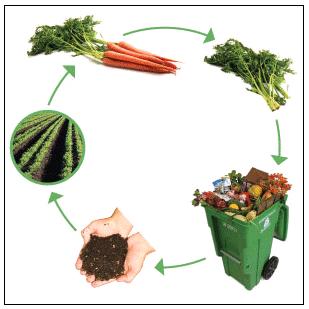
Using the same processes found in nature, it is possible to return once living food scraps into viable life-giving elements that will nourish future plant growth. Anything that was once living can and will decompose and break down into its simplest elements. Even the kitchen scraps on your plate that was once a culinary delight can some day become tomorrow’s nutrients in next year’s vegetable crop. How does this process occur? Decomposition is the process of organic matter broken down by other living organisms into the simplest elements and thus completing the plant compost life cycle.
Most folks do not have a food waste collection system in their neighborhood. So, have you considered a food waste recycling system in your own home? You probably already have one, known as the garbage disposal. About half of all homes in America have one, it is usually electrically-powered, installed under a kitchen sink between the sink’s drain and the trap which shreds food waste into pieces small enough (generally less than 2 mm) to pass through plumbing. The problem with this system is that the foodstuffs added to the sewerage treatment system and it cannot easily handle the extra load of kitchen waste disposal units. Food scraps range from 15% to 30% of household waste, and are a problematic component of municipal waste, creating public health, sanitation and environmental problems at each step, beginning with internal storage and followed by truck-based collection.1
With up to 30% of total household waste being organic food waste lost in garbage bags either to landfills, or in the sewerage treatment plants across America, we see a lot of lost compost material each year. According to the Recycling Services department at the University of Colorado in Boulder, each of us generates on average 4.4 pounds of waste per day per person.2 In addition, with the average size of households in the United States being 2.6 persons,3 this means each household adds an average of 11.4 pounds of waste per day, or 4,176 pounds of waste per household on an annual basis. This figure equates to as much as 1,253 pounds of organic food waste material generated per household in the United States on an annual basis. Moreover, did you know that the projected number of households in the United States for 2010 is 114,825,428?4
You have to wonder what the percentage of US households that currently use their kitchen food waste as compost. The amazing thing is that when you take the projected number of current households in the US and multiply that figure by total household organic food waste the figure is an astounding 143,876,261,284 pounds, which is 71,938,131 tons. To give you an equivalent in nature to compare by, the largest mammal is the blue whale, which can weigh about 150 tons5, and the annual weight in household waste material would be the same as 479,587 blue whales. On the other hand, and for optional reference and scale comparisons, if you like to equate it to manmade objects, annual household organic waste would match the weight of the ill-fated Titanic6 times 1,563.9. That is a lot of organic waste material folks!
Restaurants getting into the act
These figures do not even touch the amount of organic kitchen waste generated by restaurants, commercial kitchens, hotels, country clubs, caterers, and food manufacturing plants across the country, of which many are sending their stuffs to the landfills and sewerage treatments plants. Image how much of that kitchen waste could be converted to viable elements for gardens.
However, there are initiatives and success stories such as the Four Seasons Hotel in Philadelphia, PA that has focused on creating a cost-effective composting partnership, read more…
In another success story, the Bay Area Utility for the city of San Francisco Bay, CA has started a leftovers recycling program where electricity is generated from the methane gas produced from food decomposition, read more…
What to Compost – The IN List of kitchen and indoor household substances
- All your vegetable and fruit wastes, (including rinds and cores) even if they are moldy and ugly
- Old bread, donuts, cookies, crackers, pizza crust, and noodles: anything made out of flour! (debatable, see related links lists)
- Grains (cooked or uncooked): rice, barley, you name it (debatable, see related links lists)
- Coffee grounds, tea bags, filters
- Fruit or vegetable pulp from juicing
- Old spices
- Outdated boxed foods from the pantry
- Eggshells (crushed)
- Corn cobs and husks (cobs should be cut up)
- Cardboard rolls
- Clean paper
- Coffee grounds and filters
- Cotton rags
- Nut shells
- Tea bags
- Wool rags
What Not to Compost – The OUT List / Reasons of kitchen and indoor substances
- Black walnut tree leaves or twigs
- Releases substances that might be harmful to plants
- Dairy products (e.g., butter, milk, sour cream, yogurt) and eggs
- Create odor problems and attract pests such as rodents and flies
- Fats, grease, lard, or oils
- Create odor problems and attract pests such as rodents and flies
- Meat or fish bones and scraps
- Create odor problems and attract pests such as rodents and flies
- Pet wastes (e.g., dog or cat feces, soiled cat litter)
- Might contain parasites, bacteria, germs, pathogens, and viruses harmful to humans
Outside the Yard
Organic yard material accounts for much more volume per household than do kitchen organic wastes, especially when you consider the amount of leaves, grass, weeds, branches, and other debris created throughout the seasons. Did you know that in developing countries the average household generates up to 75% of its total waste in organic material? This is a huge increase from the 30% of organic material that households in industrialized countries create. However, much lower when compared to the total waste volumes that industrialized counterparts create, the numbers are still staggering. In many cities of developing countries, the per capita waste generation rates are near 500 grams per day, with at least 300 grams being organic material, which equates to about 0.6 pounds of organic waste per person per day.7
Developing organic wastes
Consider the population of São Paulo, the largest city in Brazil with 11,037,593 inhabitants as recorded in 2009;8 this would amount to about 6,622,556 pounds of organic waste material per day per capita for the metropolis. Annually, the city has to contend with 2,417,232,940 pounds of organic waste material, and that takes a lot of infrastructure to handle that amount of trash. In addition, the metro area of São Paulo includes a much larger population of 19,889,559, so do the math on that! Indeed, that is a lot of organic waste material. How much of this organic waste material is captured and recycled?
Closer to home…
Our homestead lot is about 0.45 acres in total size, and the house footprint takes up about one-third of that space, so we end up with about 0.3 acres of useable land area including the yard, garden, sidewalk, and driveway space. Of this space, most likely about one-fifth or 0.2 of an acre makes up the actual grassy portion of the lot.
When using the rear mower bag for the grass clippings the yard generates about eight full bags, and these get mixed into the compost pile, along with the leaves and useable kitchen waste materials. In the three weeks that I have started using the mower bag to catch the yard grass clippings two bins have become ½ full. Plans are in place to expand the compost bins to double their capacity, and 4 more pallets are in the works to be added soon.
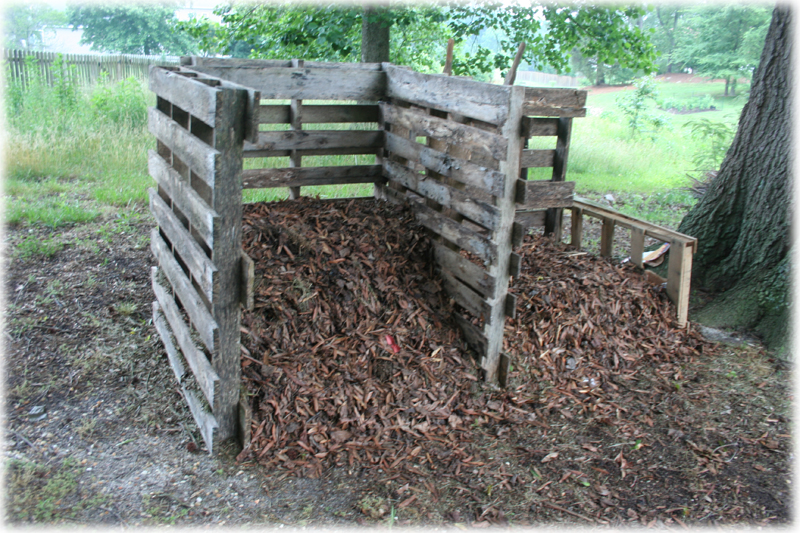
This is the simple homemade compost bin made with leftover pallets from a previous paver’s project and wire. Pallets can be wired together creating a perfect set of compost bins, and require only free pallets and a little wire to fashion them together, a simple project that takes little time and effort, and helps to recycle wood pallets that otherwise end up in the landfills themselves.
All composting requires three basic ingredients:
- Browns — Includes materials such as dead leaves, branches , twigs
- Greens — Includes materials such as grass clippings, vegetable waste, fruit scraps, coffee grounds, and other indoor household materials
- Water or moisture
The Outdoor IN List
- Animal ( cow or horse) manure
- Dryer and vacuum cleaner lint
- Fireplace ashes
- Grass clippings
- Hair and fur
- Hay and straw
- Houseplants
- Leaves
- Sawdust
- Shredded newspaper
- Wood chips
- Yard trimmings
The Outdoor OUT list / Reasons
- Coal or charcoal ash
- Might contain substances harmful to plants
- Diseased or insect-ridden plants
- Diseases or insects might survive and be transferred back to other plants
- Yard trimmings treated with chemical pesticides
- Might kill beneficial composting organisms
The benefits of composting at home, in the community, or at the restaurant, far out weight the costs. It not only saves the environment, but it directs energy and nutrients back into a complete cycle that generates new plant life.
Here are some of the known good things about composting:
- Compost contains macro and micro nutrients often absent in synthetic fertilizers.
- Compost releases nutrients slowly—over months or years, unlike synthetic fertilizers
- Compost helps bind clusters of soil particles, called aggregates, which provide good soil structure. Such soil is full of tiny air channels & pores that hold air, moisture and nutrients.
- Compost brings and feeds diverse life in the soil. These bacteria, fungi, insects, worms and more support healthy plant growth.
- Healthy soil is an important factor in protecting our waters. Compost increases soil’s ability to retain water & decreases runoff. Runoff pollutes water by carrying soil, fertilizers and pesticides to nearby streams.
When that first batch of finished compost is ready to spread, congratulate yourself for your efforts because you are ecologically minded, and know that organic materials should be recycled into the soil instead of being put in a garbage can. By recycling the organic materials, valuable nutrients and organic matter are recycled. You have helped alleviate the solid waste problem!9
Related Links
How to build a compost bin from reclaimed wood
30 things you should never compost or recycle
Compost This: Household Waste
Composting: Basic Information
What are the easiest, most important things to recycle?
Why is it Important to Recycle Paper?
References
Tags: Sustainability
Yesterday we started the recount of our tour of Philly with In the City of Brotherly Love. And we are concluding today with Philadelphia city and culinary adventures…In the City where Freedom Rings!
On Sunday, before we headed out for breakfast, My Dear Wife decided that the hotel needed to know about our nocturnal hallway events, and they proceeded to give us a free dinner for two at Thirteen! Wow! We laughed, since we had just eaten at the same restaurant the night before, but this time it would be free. We did not expect to get anything from telling them about the night, but we were feeling even better now!

So we headed back to Beck’s Cajun Café for some Beignets and Café au Lait, a real treat since they only make them twice a week on Wednesday’s and Sunday’s. It brought back memories of being at Café du Monde and ordering up a plate of the crispy French doughnuts with powdered sugar, ETL diet would have to be put on the back burner the rest of the week. The Community coffee with chicory was fantastic, and the first time I had that much coffee in me in months.

After breakfast, we headed west walking onto Benjamin Franklin Parkway; we walked around for several hours, just taking in the sights, sounds, and smells. The architecture in Philly is fantastic, including the image of city hall on the left. We were in awe of all the great buildings and fountains along the parkway. We happened upon the basilica of Saints Peter and Paul Catholic Church as a mass had just ended, after the parishioners exited, we entered the church and stumbled upon a guided tour of the interior. A fascinating thirty-minute tour filled with history and some amazing alters. Turns out the parish has only about 500 family’s on their rolls and thus survives on hosting four weddings each weekend, for the fair price of $15,000 to rent out the sanctuary, it really is that beautiful inside.

The Cathedral Basilica of SS. Peter & Paul |

Pennsylvania Railroad Building |
After the tour, we continued our walk westward along Benjamin Franklin Parkway and then turned back to the hotel; I had to report for work around 2:00 pm that day. Once we finally met up with my co-workers on the conference team we decided to have some lunch together and beat feet back to the Reading Terminal Market for some deli delights. My Dear Wife had the Corned Beef sandwich and I ordered the Pastrami sandwich, both were amazing, my boss had a Reuben sandwich, and we got a taste of that as well.
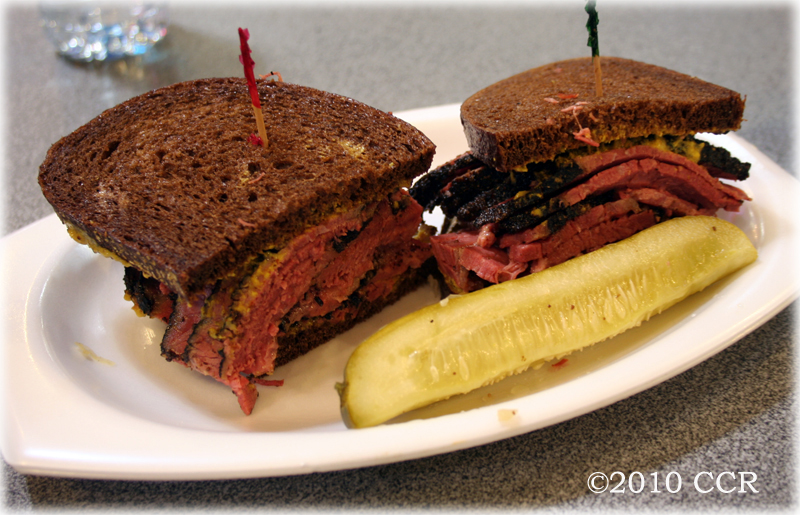
Pastrami on Rye |
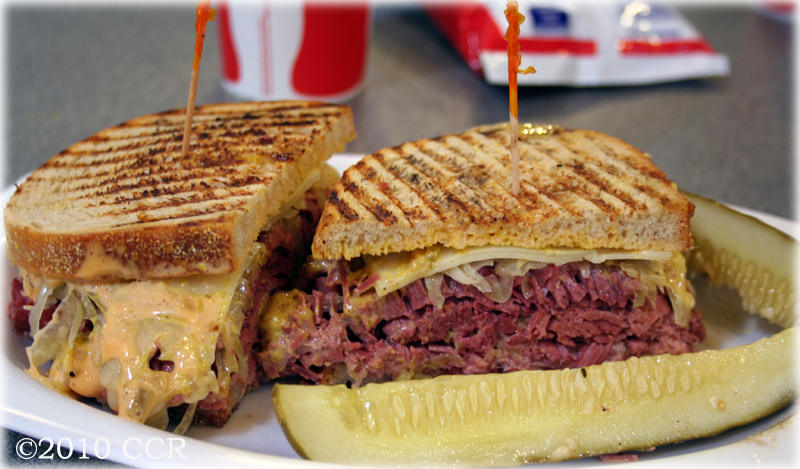
Reuben Sandwich |
After working for several hours to set up the registration desk we parted our ways, and My Dear Wife and headed back to the room to freshen up, then back to Thirteen for dinner. We were so pleased with the meal from Saturday night that we both ordered the same thing again, she the crab cakes, and I the stuffed peppers. We should have ordered something else, the salad with the crab cakes was completely different from the night before, and the stuffed peppers were slightly different as well. Still a very good meal, but not consistent with the same preparations as the previous meal, anyway, who could really complain with getting a free dinner.
For breakfast each day from Monday through Friday, we took advantage of the concierge lounge and enjoyed the fresh fruit, Danishes, oatmeal, scrambled eggs, coffee, juices, bagels, muffins, and such.
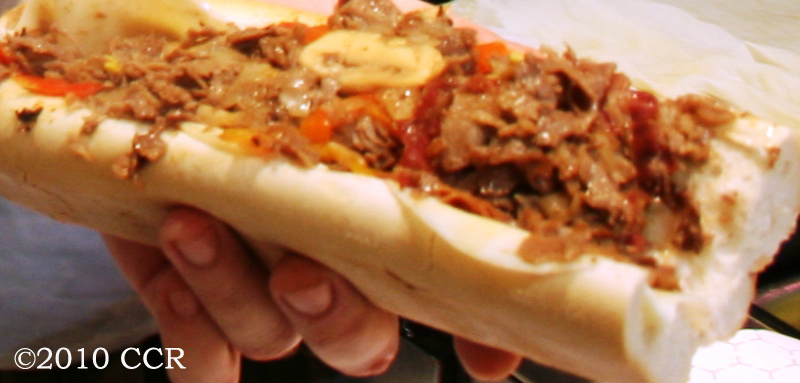
Typically, for lunch we would head out to the market for new flavors and tastes. So, Monday we finally got a taste of the popular Philly Cheese Steak sandwich, My Dear Wife and I split one with some garlic and spinach added, it was as good as any Cheese Steak I’ve ever had outside of Philly. The image at left is of another one made for someone else. By the way, if you ever want a really good Cheese Steak sandwich if you are in New Orleans, go to the Quartermaster Shack on Bourbon Street in the French Quarter, it is a little corner grocery store that also prepares meals and sandwiches.
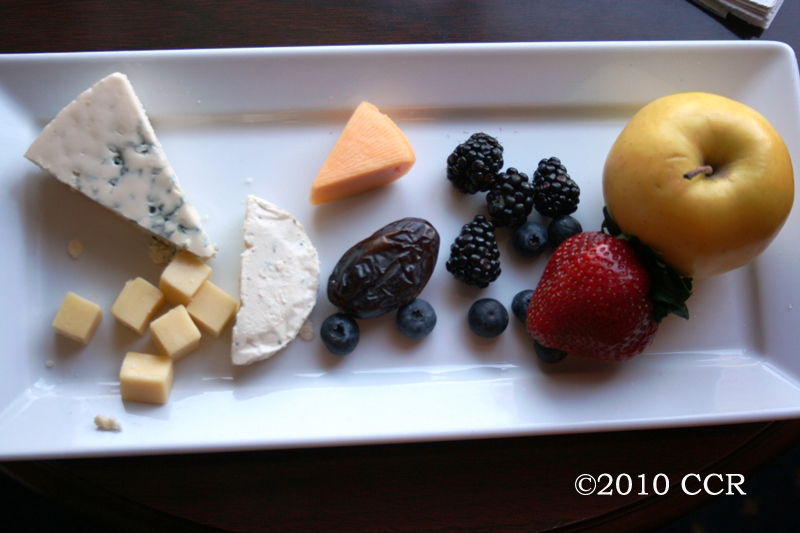
When we returned to our room that evening we found this nice fruit and cheese tray left as a complimentary treat, we snacked on this for the next day, the refrigerator we requested came in handy.
Each evening with the exception of Tuesday evening, we ate the complimentary salads, crudités, hor d’oeuvres, and desserts at the concierge lounge.
Tuesday, for lunch, My Dear Wife and I ate at Beck’s Cajun Café again and I had the Chicken and Sausage gumbo and she the Red Beans and Rice. Both were good, but I have made and had better; however, we did enjoy the flavors of New Orleans in Philly. This is most likely our only disappointing meal at Beck’s, it is hard to create good gumbo outside of Louisiana, and the red beans just needed more kick I think, I know Bill Beck can make it happen!
Tuesday evening we all ventured to the local Hard Rock Café located across the street from the hotel. We ordered and split the Grilled Hawaiian Chicken, which is billed as a semi-boneless half-chicken marinated for 12 hours in a fresh ginger soy marinade, then slowly oven roasted. The chicken is then finished on the fire grill, basted & topped with diced grilled pineapple and green onions. Served with White Cheddar smashed potatoes and fresh vegetables. My Dear Wife also ordered a side salad along with the chicken.
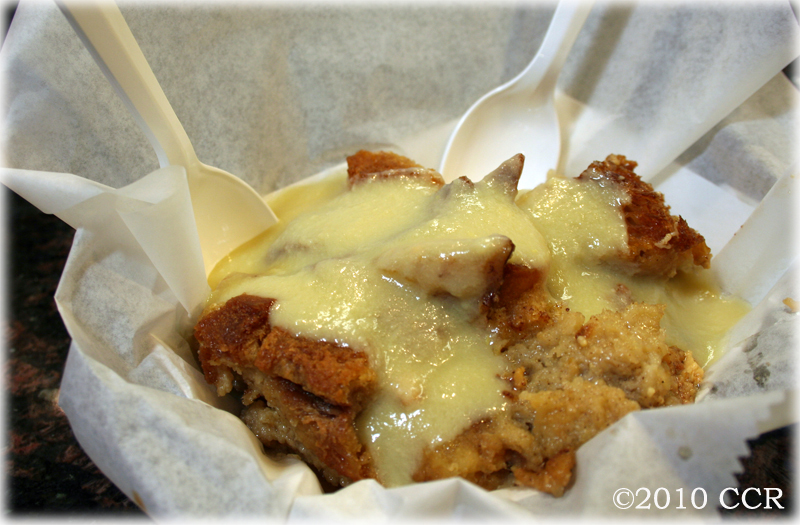
Thursday, for lunch we had our last lunch at Beck’s, we split an Oyster Po-Boy, a quarter of a Muffeletta, and an order of Bread Pudding, see image at left. The oysters were crisp and huge and tasty, the oyster loaf was as good as any found in New Orleans. The Muffeletta was on par with most pedestrian loafs found on the street in NOLA, still hard to beat the Central Grocery on Decatur Street in the French Quarter. Of course, the Bread Pudding was amazing.
Friday, we packed up after breakfast we worked a half-day, packed up the conference materials, and headed for the airport and ate some of that kiosk Chinese food, which was okay for airport food courts.
Here are a few more images from our time in Philly!
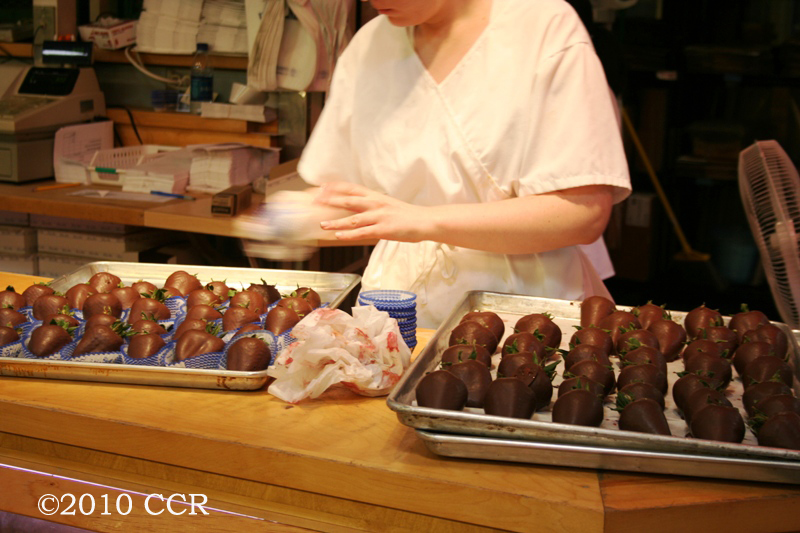
Chocolate Dipped Strawberries at the market

Produce Stand at the market

Rocky Balboa Statue
Tags: Bon Vivant · Restaurant Reviews