November 10th, 2009 · 9 Comments
Bon Vivant Travels, First Stop…South America
Today the Cajun Chef Ryan (CCR) blog is launching a new series of posts dedicated to world travel with a focus of highlighting the food, ingredients, and cuisines of the world. When our family is traveling away from home one of the things that we enjoy is tasting the local foods and ingredients, either from family owned restaurants, street vendors, cafés, markets, or other local resources. We especially enjoy finding places that the locals are known to frequent, and if we spot a place with a line out the door, it is going to be worth the wait. Cannot say the same for chain restaurants that sprout up along every major highway and Interstate exits, we try to avoid them like the H1N1. With a few exceptions, why would I want to eat at a Wendy’s, Chili’s, Applebee’s, Outback Steakhouse, Texas Roadhouse, etc…off of Interstate 10 in San Antonio, TX when I can get the same exact meal in Houston, Slidell, LA, Mobile, AL, or Gainesville, FL? And a Le Royal burger in Paris would never be on my agenda either. Variety is exactly the spice of life! Moreover, it is our hope to find a little more variety along the journey of life!
When planning trips, research well ahead of the departure date ensures locations, places of interest, local eateries, museums, National Parks, lodging, and adventures set up and align in a logical manner. Once the places of interest and locations are determined then comes the local foods and ingredients research, sometimes these finds change the course of the locations too. Foodie finds are like a scavenger hunt too, and when venturing to locations off the beaten path generally will tell you more about an area than the tourist attractions and traps. On the other side of the spectrum, and with just a general set of interests in mind, venturing can also take on a loose agenda with open-ended stretches.
 To introduce this endeavor, CCR is engaging the assistance of our long time family friend, Michael Addison. Mike moved near Shawnee, OK in 2008 for a new job but lost his position by a reduction in workforce in April 2009. After moving back in with his parents in Houston, TX, he decided to take the rest of the year off and travel the world. Once we found out about his newfound endeavor, we asked if he would be willing to send in regular updates on his travels and especially any reports on local ingredients and foods for the parts of the world that he will be visiting. He gladly accepted the challenge.
  Thus far, Mike has sent in three updates from his first segment of the journey beginning with several South American locations such as Buenos Aires, Argentina, Bariloche, Cerro de Torre Peak, Perito Moreno Glacier at Calafate, and Patagonia. Mike has always been a worldly traveler, just in the past few years he has ventured on several trips to South America, France, Europe, and South Africa. The two images are from South Argentina and Bariloche area where we see Mike is sitting at the dinner table on the far left side of the image at left, and he can be seen squatting on the bottom right side of the image at right.
Our next installment of “Bon Vivant Travels” will start with Mike’s preparations for the adventure, his arrival, and first days in Buenos Aries.
Tags: Bon Vivant · Travel
Sauce Au Poivre Vert
Green Peppercorn Sauce
Steak au Poivre is probably the most popular preparation for this sauce, but it has so many other great uses as well. Escallops of veal, veal chops, sautéed chicken breast, duck breast and even for fish filets it is a wonderfully flavored addition to any of these protein sources. Rabbit au Poivre is also a great way to enjoy both the entree and the sauce, perfection indeed.
 “Au Poivre” is the term for peppercorn in French and “Vert” means green, thus the green peppercorn. The image at the left depicts the green, white and black peppercorns and is provided under license from Rainer Zenz1. Green peppercorns can be purchased at specialty gourmet shops or from various online sources. The cans of packed green peppercorns listed in the recipe provided are 3.5 ounces each, so 7 ounces of peppercorns is utilized. The source linked provides a 3.5 oz can of packed peppercorns.
According to the book Food Lover’s Companion, by Sharon Tyler Herbst, and found on page 429, green peppercorns are the soft, under ripe berry that is usually preserved in brine. It has a fresh flavor that’s less pungent than the berry in its other forms. Green peppercorns packed in brine are available in cans or jars. They should be refrigerated once opened and can be kept for 1 month. Water-packed green peppercorns must also be refrigerated but will only keep for about a week.
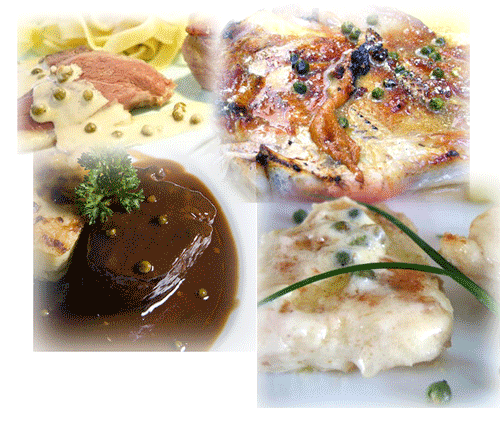 This sauce was used for menu items at the Eiffel Tower Restaurant on St. Charles Avenue in New Orleans, Louisiana. Once prepared this sauce was held in the steam table contained in a bain-marie on the sauté line station to keep warm during service. Variations of this sauce can include using a brown sauce instead of the cream based version in this recipe and several are depicted in the image on the right. Clockwise from the top left are Canard au Poivre Vert (Duck breast), Veal Chop au Poivre, Steak au Poivre, and Escalope du Veau au Poivre (Veal scallops).
Click on images for a larger view.
Yield: 5 quarts sauce
| Ingredients |
| 5 |
Quarts |
Heavy cream |
| ½ |
Cup |
Shallots, finely diced |
| 2 |
Cans |
Green peppercorns (7 ounces total) |
| 1 |
Cup |
Brandy |
| 2 |
Cups |
Oyster liquor (optional for seafood dishes) |
| 1 |
Cup |
Veal stock |
| To taste |
Salt and white pepper |
| Procedure Steps |
| 1. |
Reduce the heavy cream to sauce consistency in large saucepot. Use a wire whip to whisk while reducing to prevent boiling over. |
| 2. |
In another saucepot sweat the shallots in a little oil, then add 2/3 of the green peppercorns and crush some of them with the backside of a large spoon. Stirring well to sauté just a bit, then flame with the brandy and continue to crush the peppercorns and reducing it a bit. Pour the reduced and thickened heavy cream through a fine strainer as you add it to the peppercorns. |
| 3. |
Add the oyster liquor (for seafood preparations) and veal stock and then allow the sauce to reduce a bit to thicken over medium-low heat. |
| 4. |
Using a burr-mixer blend the sauce until smooth and most of the peppercorns are puréed. Or transfer the sauce to a blender with the center cap removed and blend until smooth. |
| 5. |
Strain through a fine sieve and season to taste with the salt and white pepper. Add the remaining 1/3 of the peppercorns to the sauce for garnish and stir. |
Reference to peppercorn image:
1As the holder of copyright, Rainer Zenz has published or publishes the work (peppercorns image) under the following license: You have permission to copy, distribute and / or modify this document under the terms of the license GNU Free Documentation Version 1.2 or any later version published by the Free Software Foundation; no Invariant Sections, no text of front cover and without text back cover.
Tags: French Cuisine · Sauces
 As one of the “mother” sauces, this egg yolk, butter and lemon juice based emulsification is always popular among restaurants with a French flair or heritage. So many variations abound from the basic template including Bavaroise, Béarnaise, Chrone, Foyot, Paloise, Crème Fleurette, Dijon, Maltaise, Mousseline or Chantilly, and Noisette. One of the side passions that I have with ingredients and preparations in particular is learning about the history and development of the particular item or recipe. In the case of hollandaise, it goes back to the foundations of French cuisine with references to a similar sauce as far back as 1651 by François Pierre La Varenne, who stated in his cookbook Le Cusinier François: “…make a sauce with good fresh butter, a little vinegar, salt and nutmeg, and an egg yolk to bind the sauce.” However, the widespread use of egg yolks and butter in the preparation did not appear until the 19th century.
From the book A Guide to Modern Cookery – Part I, and found on page 23, by G. A. Escoffier, the foundation recipe for hollandaise consists of quantities for preparing one-quart of the sauce and the ingredients listed for this 1909 version include the following.
1 ½ lb. butter, the yolks of 6 eggs, 1 pinch mignonette pepper and ¼ oz. salt, 3 tablespoonfuls of vinegar.
The only ingredient I am not familiar with in this listed in the pepper. According to Penzeys Spices, mignonette pepper is a classical blend, also known as “shot pepper,” of cracked Tellicherry black pepper, Muntok white pepper and flavorful Moroccan coriander, and traditional in French-Canadian cooking and roasting.
Escoffier preparation procedure is described – Put the salt, the mignonette, the vinegar, and as much water in a small saucepan, and reduce by three-quarters on the fire. Move the saucepan to a corner of the fire or into a bain-marie, and add a spoonful of fresh water and the yolks. Work the whole with a whisk until the yolks thicken and have the consistence of cream. Then remove the saucepan to a tepid place and gradually pour the butter on the yolks while briskly stirring the sauce. When the butter is absorbed, the sauce ought to be thick and firm. It is brought to the correct consistency with a little water, which also lightens it slightly, but the addition of water is optional. The sauce is competed by a drop of lemon juice, and it is rubbed through a tammy (a fine sieve or cheesecloth). He also provides a set of remarks – The consistence of sauces whose processed are identical with those of the Hollandaise may be varied at will; for instance, the number of yolks may be increased if a very thick sauce is desired, and it may be lessoned in the reverse case. Also similar results may be obtained by cooking the eggs either more or less. As a rule, if a thick sauce be required, the yolks ought to be well cooked and the sauce kept almost cold in the making. Experience alone – the fruit of long practice – can teach the various devices which enable the skilled worker to obtain different results from the same kind and quality of material.
Escoffier had a way of breaking down descriptions of culinary preparations that were never done before, made them easy to understand and follow. Documentation of procedures and making them repeatable, and even 100 years later we find that the basic hollandaise has not changed very much. To the novice unfamiliar to certain terms may not know about “bain-marie”, simply it is a hot water bath, or commonly known as a double boiler. Typically, one of the first sauces that a culinary apprentice will have to master is the art of making a hollandaise, as it takes skill, stamina, patience and practice to hone one that will hold up during service hours.
 When working the line at a restaurant that has hollandaise on the menu, typically it is prepared just before service time as the shelf life is not very long, it usually sits out a room temperature to avoid becoming to thin or too thick. Too much heat will cause it to break and separate, and too cold it becomes a solid mass and unable to pour smoothly. Finding the right spot in the kitchen for service storage is always a challenge. Ladling a portion of hollandaise sauce on a plated Trout Pontchartrain is depicted in the image on the left.
Here is the recipe for a typical hollandaise made at the start of service every day when working on the kitchen front lines.
| Ingredients |
| 6 |
Large |
Egg yolks, room temperature |
| 1 |
Tbsp |
Lemon juice |
| 1½ |
Tbsp. |
Water, cool |
| 1 |
Tsp. |
Crystal hot sauce |
| 1 |
Tsp. |
Worcestershire sauce |
| 1 |
Tsp |
Salt |
| ½ |
Tsp |
Cayenne pepper |
| 1½ |
Lb. |
Butter, melted and clarified |
| Procedure Steps |
| 1. |
In a large stainless steel bowl set over a pot of simmering water (bain-marie), add the egg yolks, lemon juice, water, hot sauce, Worcestershire sauce, salt and cayenne pepper. |
| 2. |
Whisk the ingredients with a wire whip until it becomes a pale light yellow color, the volume increases to almost double and when the whip is lifted, it creates a slightly thick ribbon effect. |
| 3. |
Remove the bowl from the hot water bath and while continuing to whisk, slowly add the clarified butter in a slow steady stream. Start with just a few drops of the butter first, and then gradually increase the amount as incorporating, but not too much at once. This is creating the emulsification of the butter into the egg yolks, but speeding up this process will result in a broken hollandaise. This is the tricky part of the whole process, ensuring that the eggs are ready to accept the butter, and that the butter is not added to quickly. |
| 4. |
If the hollandaise seems too thick then gradually add more water to thin out some. |
One tip to keep your stainless steel bowl from moving around while whisking in the butter is to place it onto a damp towel, this will keep it stable as you whip with one hand and add the ladles of butter with the other hand.
Several menu items served with a hollandaise sauce include the Veal Oskar with crawfish tails and white asparagus on the left and Sweetbreads with Hollandaise on the right.


Tags: French Cuisine · Sauces
November 2nd, 2009 · 7 Comments
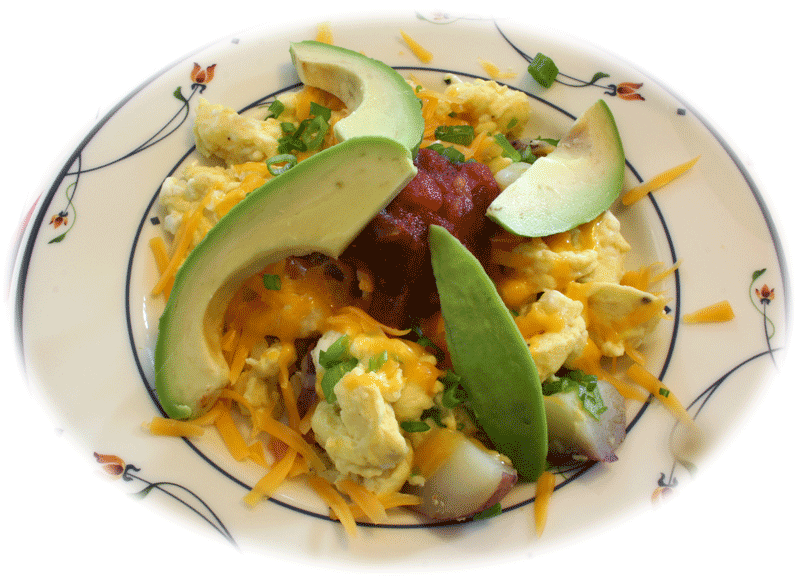 Something about eggs, cheese and salsa makes for a perfect breakfast, brunch, or evening meal. No matter the time of day, eggs have an appeal that transcends all meals and just about every occasion. We enjoyed a batch of salsa and avocado laden scrambled eggs with shredded cheddar cheese, quartered new red potatoes, and a sprinkling of chopped green onions. A delight indeed, as this recipe will make enough for two servings, and easily adjusted for four or six servings as well. Simple elegance is always a treat and this quickly prepared meal fits both.
Yield: 2 portions
| Ingredients |
| 4 |
Large |
Eggs |
| ¼ |
Cup |
Milk |
| ¼ |
Tsp |
Salt |
| ¼ |
Tsp |
White pepper |
| ½ |
Tbsp |
Butter |
| ½ |
Cup |
New red potatoes, boiled whole until tender, quartered with skin on |
| ½ |
Cup |
Cheddar cheese, shredded, divided |
| 2 |
Tbsp |
Salsa, divided |
| 1 |
Whole |
Avocado, sliced into eights and divided |
| 1 |
Tbsp |
Green onions, chopped, divided |
| Procedure Steps |
| 1. |
Crack and whisk the eggs with the milk and the salt and white pepper. |
| 2. |
Melt the butter over medium heat and add the quartered new potatoes to heat through and brown a little then add the egg mixture and scramble until cooked through. |
| 3. |
Portion the cooked eggs and potatoes mixture onto two serving plates. |
| 4. |
Garnish each plate with evenly divided portions of the shredded cheese, salsa, avocado and then the green onions. |
Tags: Breakfast · Mexican · Recipes