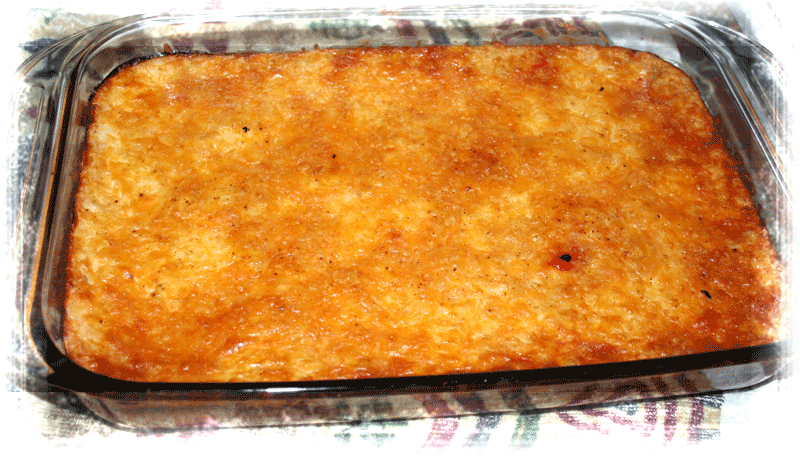
 I have heard many folks mention that corn casserole has been a favorite in their family for years, we just tried it for the first time this past Christmas during our Mountain Cabin Adventure, and it may become a new tradition for our family too! This version is adapted from the Curves “Women In Motion” December 2009 newsletter is a great and healthy way to enjoy corn. We substituted some of the ingredients, replacing the low-fat shredded cheddar cheese with finely shredded Mexican four cheese mix and increasing doubling the amount , and the original recipe called for egg substitute, we used read eggs instead. In addition, we added some extra virgin olive oil for sautéing the onions and peppers, the original recipe called for non-stick spray here. Therefore, the dish we ended up with and re-created here might not be as low in calorie and fat as Curves intended, but that is why we love to cook, always making a recipe our own. Other than those three ingredient changes, we followed the rest and the procedures remained the same.
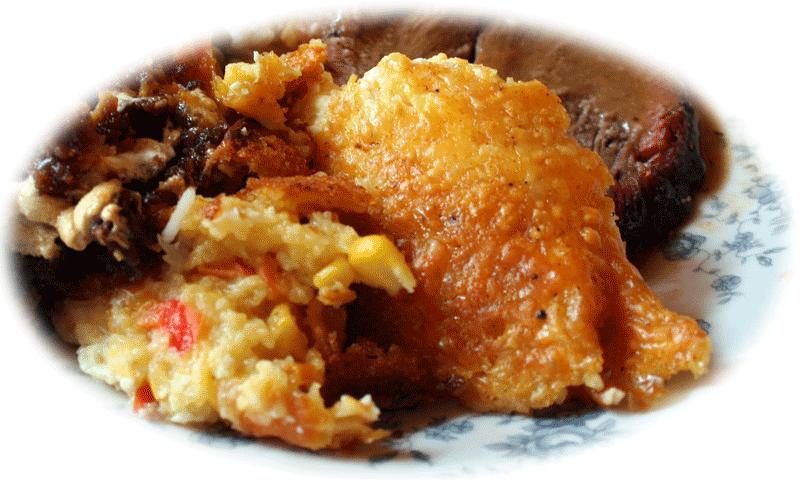 I would think that this side dish casserole would be good anytime of year, in fact, an addition of chopped jalapeno’s, and green and yellow peppers would also add some color and flavor too.
Here is our version listed for your dining enjoyment. Above here the casserole pictured with the Christmas Cabin dinner meal which also consisted of the smoked leg of lamb, smoked turkey breast, bourbon sweet potatoes, rice, and peas. Note, click images for a larger view.
| Ingredients |
| ½ |
Tbsp |
Olive oil, Extra Virgin |
| 1 |
Medium |
Onion, chopped |
| 1 |
Large |
Red bell pepper, chopped |
| 1 |
Can |
Whole kernel corn, drained |
| 1 |
Can |
Cream-style corn |
| 1 |
Pkg. |
Corn bread mix, 7.5 ounces |
| 1/3 |
Cup |
Eggs, beaten |
| 8 |
Ounces |
Fat free sour cream |
| 1 |
Cup |
Shredded Mexican four cheese blend |
| Procedure Steps |
| 1. |
Coat a sauté pan with a little olive oil and then sauté the onions and peppers over medium heat until the onions are translucent, and peppers are tender. |
| 2. |
In a large bowl, combine the two cans of corn, corn bread mix, and eggs. |
| 3. |
Once the onions and peppers are done stir them into the bowl with the other ingredients. |
| 4. |
Pour the ingredients into a 2-quart baking dish coated with non-stick spray or greased with butter. |
| 5. |
Combine the sour cream with the shredded cheese and then spread this evenly on top. |
| 6. |
Bake for 1 hour in a 350° F. or until a toothpick or knife inserted comes out clean. Then let stand at least 10 minutes before serving. |
Tags: Curves · Holidays · Recipes · Vegetarian
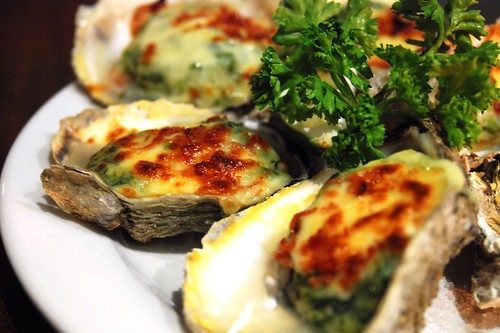 One of the appetizers famously served in many a New Orleans restaurant and goes back to the days of Antoine’s Restaurant. Founded in 1840 by Antoine Alciatore this dish was created by Jules Alciatore in 1899, the son of the restaurant’s founder.
The dish was named after John D. Rockefeller, the richest American at the time and follows in the same richness of the sauce.
The original recipe is still a secret today, however the main ingredient that most folks use today is still spinach, and some opinions differ on the other green ingredients but guess at them being parsley and watercress that are pureed and added to the mix. Historically, it seems the original recipe may have been taken to the death bed of Jules Alciatore, as current Antoine’s chefs deny any spinach in the recipe, some folks support the notion that the primary ingredients are parsley, celery, scallions or chives, olive oil, and capers.
The historical mystery surrounding this famous dish still thrives today, but the version presented here from the Columns Hotel as it was served in the mid 1980’s curing the Chef Chris Canan and Brian Coates days, still holds as a superlative addition to any restaurant menu.
If you are visiting New Orleans, especially now during Mardi Gras season you can still order Huitres en coquille a la Rockefeller (notre creation) $12.00, Oysters baked on the half shell with the original Rockefeller sauce created by Antoine’s in 1889 at Antoine’s Restaurant.
Raw oysters on the half shell are covered with the Rockefeller stuffing/sauce and then typically are topped with cheese and then baked in a high heat oven until browned. Alternatively, roasted for about 15 to 20 minutes in a 425° F oven. Also, typically once baked a hollandaise sauce is dolloped on top of each oyster and then browned quickly under the broiler before service.
The recipe below makes quite a large batch, so you may want to cut it in half, or you can freeze any left over portions for several weeks.
Rockefeller
| Ingredients |
| 3 |
Lb. |
Spinach, chopped |
| 4 |
Med |
Onions, minced |
| 1 |
Stalk |
Celery, minced |
| 2 |
Each |
Bay Leaves |
| 2 |
Tbsp |
Garlic, minced |
| 8 |
Ounces |
Anisette liquor, Herbsaint, or Pernod |
| 1 |
Tsp |
Cayenne pepper |
| 2 |
Tsp |
Fennel seed |
| 1 |
Tsp |
Dry mustard |
| 1 |
Ounce |
Worcestershire sauce |
| 3 |
Quarts |
Chicken Velouté sauce |
|
| Procedure Steps |
| 1. |
Thaw the spinach if frozen and drain well. |
| 2. |
Pass the spinach through a meat grinder and press it to remove any extra moisture. |
| 3. |
Combine the onions, celery and garlic |
| 4. |
Sauté the onions, celery, garlic and bay leaves in a small amount of oil until soft. |
| 5. |
Add the liquor and flame. |
| 6. |
Add the cayenne, fennel, and dry mustard and Worcestershire sauce and stir well. |
| 7. |
Add the Velouté sauce and stir well then heat through for 15 – 20 minutes. |
| 8. |
Remove from the heat and fold in the spinach, then transfer to pans and allow to cool over night before using. |
|
Can be frozen in 1 lb portions for future usage. |
Image courtesy of Flickr and posted by ~maan~
Tags: Appetizers · Columns Hotel · Culture · French Cuisine · Mardi Gras · Recipes · Seafood
 One of the “Smoked Entrée of Day” menu items on the Columns Hotel menu was the Smoked Leg of Lamb with Rosemary Sauce, which sold for $12.50 per plate. The meat smoker in the back was usually filling the neighborhood with mesquite, hickory, oak, or pecan smoke aroma on a typical day.
I recreated this dish at home and was part of our Christmas Day meal at the cabin.
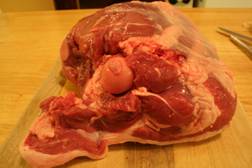
Leg of lamb is typically sold with the bone in and weight around 5 to 7 pounds each, but before they can be prepared for service a bit of butchering must be completed to remove the bone(s). Once the bone is removed, the leg is stuffed with fresh rosemary leaves and then tied with butchers twine to hold it up in one piece.
Once tied up the lamb leg is marinated overnight in a simple red wine and water liquid and the next morning is set out to the smoker.
After the smoker is set up with a hot fire and some wet wood, the prepared and seasoned leg of lamb is placed on the smoker pit for six to eight hours for a cool smoke. Once the smoke is completed the leg of lamb can be refrigerated for up to 3 days before roasting, which is about 15 to 20 minutes per pound, or about 1 ½ hours in a pre-heated 350° F oven. The complete butchering tips and images are described below. For more details on how to smoke meat check out the Smoked Seafood Salad recipe, it has a primer on smoking foods.
Removing the Bone
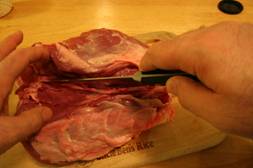
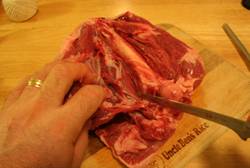
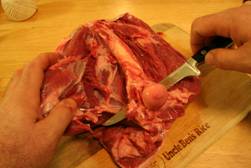
The first step is to find the bone and start separating the muscle from the connective tissue to get to the bone. Then making cuts around the bone to remove any muscle and connected tissue. Once the bone is removed, the bone cap is cut out and the leg meat is now boneless.
 |
 |
| Lamb leg with bone exposed |
Making first cuts with boning knife |
|
 |
 |
| Cutting away from the bone |
Knife under bone, almost done |
|
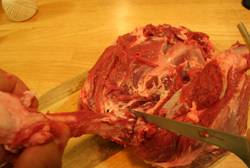 |
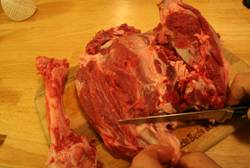 |
| Final cuts removing bone |
Removing bone cap |
Removing Fat and Silver Skin
Then the next step is to remove some of the fat and silver skin from leg using a boning knife.
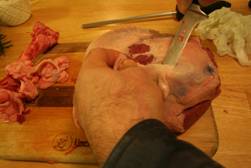 |
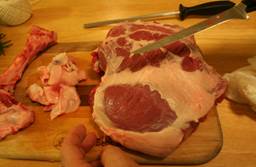 |
| Cutting a thin layer of fat & silver skin |
More leg muscle meat exposed |
|
Stuffing and Tying
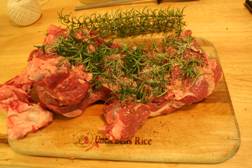
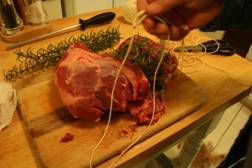
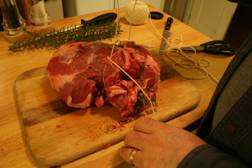
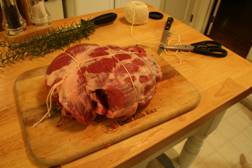
Next is to add the rosemary leaves and seasonings, then to tie it up into a nice whole piece. |
 |
 |
| Rosemary leaves added |
Starting with the butchers twine |
|
 |
 |
| Continuing with tying the leg |
Leg of lamb all tied up |
|
Marinating
Once the leg is tied up it is now ready to marinate. The marinade consists of red wine, water, garlic, salt and white pepper. The total amount of marinade varies depending on the number of legs prepared, but for this one leg it was 1 ½ cups red wine, ½ cup water, a few cloves of garlic, and one teaspoon each of salt and white pepper. The ingredients are mixed and then added to a plastic bag with the lamb leg, and then it all sits in the refrigerator overnight. |
|
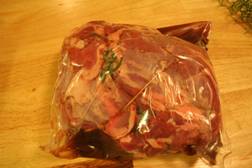
Marinating the lamb leg in a zip-type bag. |
Smoking the Meat
The next morning I stoked up the smoker, soaked the wood, and set the leg of lamb along with a turkey breast too. About seven hours later the perfectly smoked foods are ready to be refrigerated for later use, or roasted in the oven until done and ready for service time.
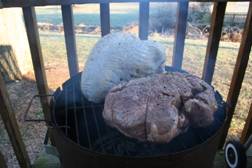 |
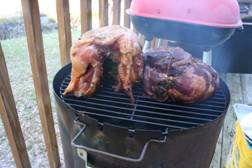 |
| Fresh marinated meats on the smoker |
Seven hours later, ready to chill or roast |
The rosemary sauce served with the lamb made from a lamb stock reduction, red wine, garlic, shallots, and fresh rosemary leaves. The lamb stock reduction was made with the lamb bones, which were cut in half to expose the inside marrow for more flavor and then covered with cool water. A cut up onion, celery, and carrot were added to the stock and brought to a slow simmer, then allowed to continue simmering for 4 hours. The liquid is strained from the stock then allowed to reduce by half, and then the red wine, garlic and shallots are added with the fresh rosemary. Again, quantities vary depending on your taste and quantity of liquid. This is brought to a simmer for 30 minutes, then strained again, and thickened either with a dark roux or with Wondra flour slurry.
Cutting and Plating
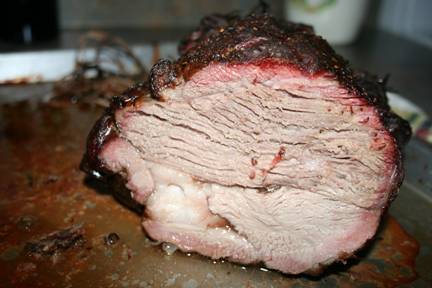
Nice smoke ring around the lamb leg
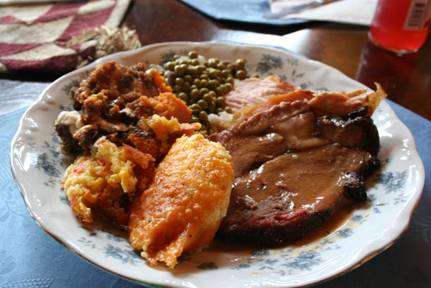
Smoked Leg of Lamb with Rosemary Sauce
Tags: Columns Hotel · Entrees · Holidays · Recipes

The Carnival Season in New Orleans commences on January 6, or Twelfth Night, and concludes at Midnight of Mardi Gras (Fat Tuesday), which is February 16th this year. The first seasonal King Cake is baked for Twelfth Night parties and the first parade rolls on the St. Charles Streetcar lines in Uptown New Orleans. Originally an uncooked dry bean, but more recently a small plastic baby figure is inserted into the bottom of the baked cake. The lucky person who finds the “baby” in their slice of cake is crowned “king or queen” for the day. The traditional Carnival colors of purple, green and gold (yellow) are depicted in tinted sugar on the top of cake.
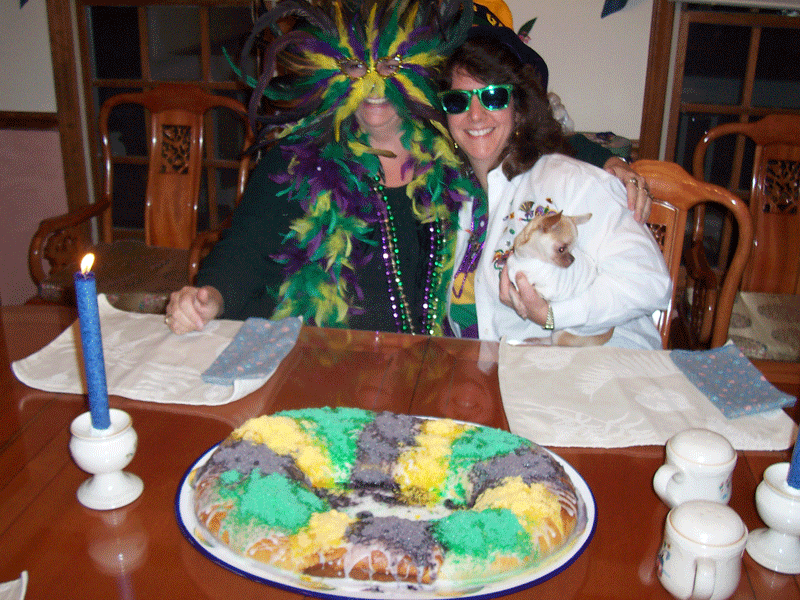
This traditional King Cake recipe goes back to before the 1980’s and is a classic. It will yield 1 average 12 to 14-inch ring of King Cake. In the restaurant I would make a much larger batch that would yield 6 King Cakes this size. The size will also increase a bit with the addition of a filling. This is typically a small sized King Cake, however, in the bakeries and stores you have a choice of small, medium or large cakes available. Extra large King Cakes have been known to be made on special orders, but for very large parties it is customary to order a number of them to fulfill the crowds.
King Cake Dough
| ½ |
Cup |
Warm water (110 degrees F.) |
| 2 |
Pkg |
Active dry yeast |
| ½ |
Cup |
Sugar (plus 2 tsp) |
| 4½ |
Cups |
All purpose flour, un-sifted |
| 1 |
Tsp |
Nutmeg, ground or fresh grated |
| 2 |
Tsp |
Salt |
| 1 |
Tsp |
Lemon zest |
| ½ |
Cup |
Warm Milk (110 degrees F.) |
| 5 |
Each |
Egg yolks |
| 1 |
Stick |
Butter, (plus 2 Tbsp) softened |
| 1 |
Each |
Egg and 1 Tbsp milk beaten (egg wash) |
| 1 |
Tbsp |
Cinnamon |
| Procedure Steps |
| 1. |
In a small bowl add the warm water and sprinkle in the yeast with 2 teaspoons of sugar. Allow the yeast and sugar to rest for 5 minutes then mix well. Set the bowl in a warm place for 10 minutes, or until the yeast bubbles and mixture almost doubles in volume. |
| 2. |
Combine 3½ cups flour with ½ cup sugar, nutmeg and salt, then sift into a large mixing bowl. Stir in the lemon zest. |
| 3. |
Create a “hole” in the middle of the bowl with the flour mixture on the sides of the bowl. Gently pour in the yeast mixture and the warm milk into the flour mixture. Add the egg yolks and combine the dry ingredients with the wet mixture. When the dough is smooth cut in the stick of butter 1 Tbsp at a time and continue to fold and combine until the dough can be formed into a soft ball shape. |
| 4. |
Place the ball of dough on a lightly floured surface and knead adding up to another cup of flour in small tablespoon portions at a time. Continue to knead the dough until smooth, shiny and elastic, about 10 minutes or so. |
| 5. |
Using a pastry brush, coat the inside of a large bowl evenly with 1 Tbsp softened butter. Place the dough ball in the bowl and rotate until the entire surface is buttered. Cover the bowl with a kitchen towel and place in a draft-free place for about 1½ hours, or until the dough doubles in volume. Using a pastry brush coat a large baking sheet pan with 1 Tbsp of butter and set aside. |
| 6. |
Remove the dough from the bowl and place on a lightly floured surface. Using your fist punch down the dough with a heavy blow. Sprinkle cinnamon over the top and roll the dough into a cylinder or tube shape. Twist the dough to form a curled cylinder and loop it onto the buttered baking sheet pan. Pinch the ends of the dough together to complete the circle. |
| 7. |
Cover the dough with a kitchen towel and allow to rise again in a draft-free warm location for about 45 minutes or until the dough circle doubles in volume. |
| 8. |
When ready to bake the dough, pre-heat oven to 350 degrees F. Brush the top and sides of the dough with the egg wash and bake on the middle rack of the oven for 30 minutes, or until golden brown. Cool cake to room temperature on a wire rack. Now is the time to hide the bean or plastic baby. |
| Tinted Sugars |
| 1½ |
Cups |
Granulated sugar |
| ¼ |
Tsp |
Purple food color |
| ¼ |
Tsp |
Green food color |
| ¼ |
Tsp |
Yellow food color |
| Procedure Steps |
| 1. |
While the cake is cooling prepare the tinted sugars by taking three separate bowls with ½ cup of sugar in each. Then take the purple food color and slowly drop a dot or two at a time into the sugar. Using a spoon stir to mix and spread the color around until all sugar is tinted. Add more food color as needed. Repeat the process for the green and then the yellow in their own bowls as well. Set the tinted sugars aside. |
| Icing |
| 3 |
Cups |
Powdered confectioners sugar |
| ¼ |
Cup |
Fresh lemon juice, strained |
| 3 to 6 |
Tbsp |
Water |
| Procedure Steps |
| 1. |
Combine the sugar, lemon juice and 3 tablespoons of water in a deep bowl whisking until smooth. If icing is too stiff whisk in 1 tablespoon water at a time until spreadable. |
| 2. |
Place cooled cake onto a serving platter or heavy cake cardboard and coat the top and sides of the cake with the icing. I like to dip my fingers into the icing and then drizzle it over the top of the cake. While the icing is still fresh immediately sprinkle the tinted sugars in individual rows about 2 to 3 inches wide of the purple, green and gold (yellow). |
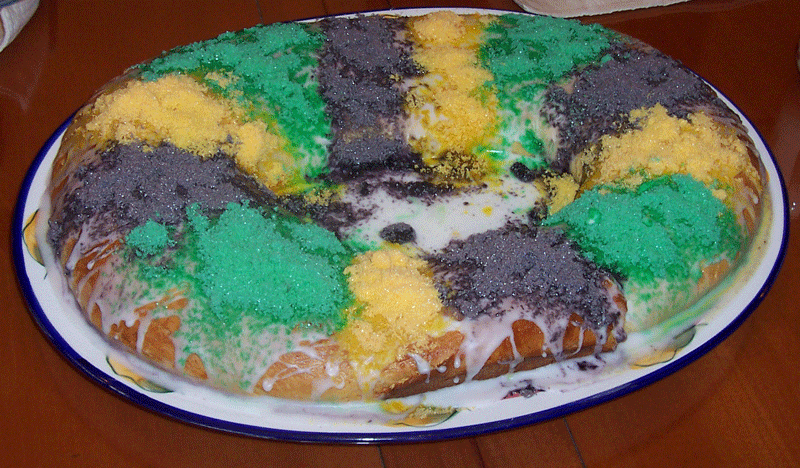
If preparing in advance allow the icing and tinted sugars to set up a bit then cover with a plastic bag or plastic wrap. Typically a King Cake can last 2-3 days un-refrigerated.
Note On Fillings: If filling the cake you will want to have your filling prepared prior to the step where you are twisting the dough. In fact, for filled King Cake dough’s I will roll the dough out similar to cinnamon roll or Danish dough style, instead of the cylinder shape as described above. Then I will sprinkle more cinnamon sugar and then add the filling. Then the dough will get rolled up around the filling jelly roll style. Then the filled dough is added to the baking sheet pan and looped into the circle and pinched before the second rising and baking stages. Typical fillings include sweetened and softened cream cheese, cherry pie filling, blueberry pie filling, lemon filling, custard filling, and my favorite is a double chocolate chocolate cake filling. Typically any pie or doughnut filling will work, you are only limited by your imagination.
Here is a typical cream cheese and fruit filling recipe:
| Cream Cheese and Fruit Filling |
| Ingredients |
| 1 |
Can |
Cherry, apple or apricot pie filling (16-ounces) |
| 8 |
Ounces |
Cream cheese, softened |
| ¼ |
Cup |
Sugar |
| 2 |
Tsp |
Flour |
| 2 |
Each |
Egg yolks |
| 1 |
Tsp |
Vanilla extract |
| Procedure Steps |
| 1. |
Using a floured roller on a floured surface, roll out the dough into a 30-by-9-inch rectangle as thin as pie crust. Let dough rest. |
| 2. |
If necessary, drain extra juice from pie filling. Mix the softened cream cheese with the sugar, flour, egg yolks and vanilla. Spoon an inch-wide strip of fruit filling the length of the dough, about 3 inches from the edge. Spoon the cream cheese mixture alongside the fruit, about 3 inches from the edge. Brush the exposed dough with egg wash. |
| 3. |
Fold or roll one edge of dough over the cream cheese and fruit in jelly roll fashion, and continue to roll the dough to the end, then brush with a little egg wash. Gently place one end of the filled rolled dough onto the buttered baking sheet pan, and then ease the rest of the roll onto the pan, joining the ends to form the loop or circle. Add more egg wash to “glue” the ends together. And then pick up from step 7 in the dough procedures above. |
Twelfth Night Starts Mardi Gras Season
The first parade in New Orleans tonight is the krewe affectionately known as the Phunny Phorty Phellows with their annual 12th Night Streetcar Parade starts and ends at Beauregard Circle, at N. Carrollton Ave. near City Park and travels down Carrollton to Canal Street, turning at St. Charles Avenue, continuing to Napoleon Avenue where it turns and retraces its route to Lee Circle, Carondelet Street, Canal and Carrollton. The maskers will assemble on the neutral ground, 6:30 Sun., and board the streetcar at 7.
The Krewe of Alla hosts the first parade of the season, 1 p.m. Sun. in downtown Gretna, in addition to its traditional parade on Jan. 27, featuring 10 floats, including one from Grela, and marching bands. It begins at the base of the Crescent City Connection at Franklin Street, travels down Franklin, turns right at Stumpf Boulevard, left at Fifth Street, left at Lafayette Street, right at the West Bank Expressway and right at Huey P. Long Avenue, concluding at the end of Huey P. Long in downtown Gretna.
The Krewe of Claude begins their parade at Salmen High School off Pontchartrain Drive, ending at the Midtown Square shopping center off Gause Boulevard, Slidell and features krewe floats, a Sweet 16 float, and units including the Moss Point, Miss., High School band, St. Mary’s Academy New Orleans band, Salmen High School color guard and band, the Baby Dolls dance team, Galloway’s dance team and the Northshore Classic Car Club, 1 p.m. Sun.
Mystic Krewe of Satyricon hosts its 12th Night Ball at the Country Club, 624 Louisa St. The 6th annual gala benefits the krewe’s Carnival ball and features an open buffet, cash bar, silent auction and music by a deejay, 7-11 p.m. Sat. Tickets are $20 in advance, $25 at the door. Dress is cocktail attire. Call 525-4498.
A King Cake Kick Off Party will be held at Trinity Lutheran Church, 438 Oliver St., Algiers Point. Food, King Cake, German beer and entertainment by Benny Grunch and the Bunch, noon Sun. Call 368-0411.
Benny Grunch and the Bunch headline Mid City Lanes Rock and Bowl’s annual Twelfth Night celebration Sunday. The Bunch is enjoying their busy season and are now gearing up for Carnival. If you haven’t seen the band, they specialize in what only can be described as a very home town, lyrically influenced, “Weird Al” type of show.
Tags: Cajun · Desserts · Heritage · Holidays · Mardi Gras · Recipes