One of the things enjoyed most about the Internet is the social book marking sites and the wide variety of links to great information that would otherwise not get to see. Here are some highlighted shares from associates, friends, foodie’s, and fellow Stumble Upon, Twitter, Food Buzz, and Delicious members over the past few weeks, and keeping them related to cooking, food, kitchens, and all things culinary. The links below are for some news, some recipes, some future concept kitchen and cooking ideas (Hello Jetson’s), a food museum, and a quirky piece on cheese.

Four Oyster Stew recipes from around the globe…
From NPR Kitchen Window, an article by Laura McCandlish on oyster stews from around the world: Oyster Stew: Four Ways To Warm Up Cool Nights
Ever make your own red wine vinegar…
Healthy Chef Dude shows you how and why you should be making your own vinegar in this video from his restaurant kitchen: How to Make Red Wine Vinegar
Sterilize your own water with this future concept…
Another Green Technology item listed on the Concept future technologies site has an article about a new UV water sterilization concept: The innovative STER UV water sterilization, concept
A museum for food and wine…
Did you know that there is a museum dedicated to just food and beverages? Yes, the Southern Food and Beverage Museum located in the Riverwalk in New Orleans, LA is devoted to preserving the history and heritage of the delicious and distinctive culinaria of the South, another great reason to visit the Crescent City: Southern FOOD & Beverage Museum

Diagnose your own nutrient requirements with this future concept…
From a Stumble Upon share, an article on a new idea for a kitchen tool that can tell you what nutrients your body needs and what is contained in a specific scanned ingredient, such as a whole fish: Diagnostic kitchen of the future
Heart is where the home is in this new tool…
You have probably seen the Kelly Ripa cake-baking contest with the Electrolux range giveaway and some fellow food blogger’s who participated in the contest! Nevertheless, did you know that Electrolux has under development a new kitchen “Heart of the Home” that will change the way we experience our kitchens – for good? Featured in this piece from the NY Daily News is an article by Catey Hill, with a video from Electrolux: VIDEO: Revolutionary new Electrolux ‘Heart of the Home’ kitchen does away with pots and pans
How does your county and state fit in with eating habits…
From Good.is/Good Blog is a map of America’s eating habits, including state-by-state comparisons of per capita spending on fast-food per person, gallons of soft drink per person, pounds of meat and poultry eaten per person, pounds of fruits and vegetables eaten per person, in this article by Andrew Price: Mapping America’s Eating Habits. Also, Daily Yonder, Keep It Rural, has a list of the fast food and other facts listed by each county in America, in this article: Most Fast Food Per Person and Other Food Facts

For a great laugh, Wendy McClure has some great quotes…
If you want to laugh your socks off, this site has some of the funniest quotes at the expense of some 1970’s circa Weight Watchers recipe cards, all put together by Wendy McClure: Weight Watchers recipe cards from 1974
Mother’s Breast-Milk Cheese…oh my….
A Twitter and Facebook post by Foodservice.com, one chef is experimenting with his wife’s breast milk for making cheese in this article from Grub Street New York, daily food news from nymag.com: Klee’s Daniel Angerer Invites You to Taste His Wife’s Breast-Milk Cheese
Butchers, the new culinary rock star…
In addition, one last interesting item found in this article about butchers being the next rock stars of the culinary world. Indeed, as more people are getting back to the roots of food, cuisine, and learning the finer arts this is not a surprise, butchering class was one of the most fun for culinary students. Watching a whole side of beef being broken down in the individual cuts is quite a show. During the culinary apprenticeship, I watched as the Hyatt Regency Hotel New Orleans butcher broke down a side of beef in about an hour or less. Amazing skill and expertise to make all the cuts in record time, and in this article Jackie Burrell of the Contra Cost Times has this article in the San Jose Mercury News: Butchers are suddenly the rock stars of the culinary world
Tags: Commentary
Guest Blog Post ~ David Bakke from Your Finances 101

Today I want to introduce you to David Bakke; he is the author of Your Finances 101 blog, where he writes about Saving More, Spending Less, and Generating Extra Cash in Your Life. In David’s guest blog post today he is going to give us some tips on grocery shopping in a frugal sense, we can all use tips with saving some money, and David has some great advice on how to stretch your grocery dollars. When you have a minute check out David’s blog, Your Finances 101, for more great personal financial tips.
Frugal Shopping 101: Are Those Blueberries Really on Sale?
By David Bakke

A very important part of fixing your overall financial picture (and one that is often overlooked) is making sure that you are maximizing your grocery-shopping dollar. Groceries are probably your second biggest monthly expense behind your mortgage/rent payment.
Over the years, I have picked up quite a few good tips and strategies on how to get the most from your weekly trip to the grocery store.

Here is a quick story. I do my grocery shopping at four different outlets. I use our local farmer’s for the majority of our purchases (we are vegetarian), I use two national outlets for our other needs, and then we use a specialty store for some organic purchases that we make.
Recently, I noticed something very interesting about blueberries. Kroger’s had a sign that said “Blueberries: 2 for $4.00”. Publix had theirs advertised “On sale: 2 for $5.00”. Trader Joe’s had them advertised as being “On special: $2.99” and finally, the farmer’s market had no advertising at all, just a simple price tag of $1.79.
This story brings up several key points that allow me to save the most on my grocery shopping.

First, find and use a local farmer’s market! Their produce prices are incredible—really! I have never tracked it, but I would estimate that their prices are consistently 20%-25% lower than that of the national chains. About the only time I do buy any kind of produce at a national chain is when I forget an item at the farmer’s market. In addition, any of you who might be getting visions of people scrounging through subpar tomatoes to get the few good ones that might be in there—have no fear. The quality of the veggies, as far as I can tell, is just as good as that of your major grocers. Also, the selection is much better as well. You should find that these farmer’s markets carry many items you just do not find at your major grocers. This could even allow you to expand your menu at home when doing your cooking.
Second, spread out your purchases. I used to do all my grocery shopping at one national chain. Until I saw the light. I save tons at the farmer’s market, and Publix always has several items that I regularly buy at a cheaper price than Kroger’s. Finally, I use Trader Joe’s when I want to “treat” myself and they have some good specials from time to time as well. Moreover, on a side note, make sure you get on the mailing lists of these grocers. From time to time, they send out coupons via direct mail, that are usually tailored to the items that you buy the most.

Third, know your prices! Three of my four grocers had advertised “sales” on blueberries, but as it turns out, the place with no advertising at all had the cheapest price. Now, is it important to know a good price on an item that you might buy once every two or three months? Absolutely not! But for the things you consistently buy, know what a good price is. Also, as you can see, just because an item is “on sale” does not mean you can’t find it somewhere else at a cheaper price.
I also try to check online circulars/flyers before heading out each week, to give me a heads up on which chains have which items on special. Since I do most of my non-produce shopping at Kroger’s and Publix, a quick glance at their online circulars before my weekly trip out usually gives me a good idea of where I want to buy my particular items. It is maddening to pick an item up at one grocery store, only to go to the next one and find it less expensive.
Am I trying to make your grocery shopping into a marathon? Something you stay up till the wee hours of the morning, staring bleary-eyed at your computer screen, trying to save 15 cents on a gallon of milk?
Hardly! Before I changed my shopping habits, I spent about an hour per week doing grocery shopping. Guess what? Now, I might spend 1 ½ hours. It takes a little research and shopping around in the beginning, but once you factor in these new habits into your weekly routine, you’ll find that it doesn’t take that much extra time at all.
I truly believe that grocery shopping, done correctly, is an art. And since it is my second biggest monthly expense, I think it is well worth investing a little time into to make sure that you are getting the most out of your shopping dollar.
For more ideas about how to save more and spend less in your everyday life, visit me at Yourfinances101.
Tags: Commentary · Frugal Cooking · Guest Blog Post

Typing out recipes for the documentation project is an ongoing process while converting them from hardcopy to digital format, and while the endeavor has been fruitful, it has been time consuming. If the resources were available, I would pay someone to manually transfer the manuals, binders, and scribbled recipes on stacks of notepaper into scanned files or typed documents; and it would most likely take a month or so of full time work, or about 160 labor hours to complete.
Lately we have been putting up recipes that are new and found from various cookbooks in our collection, primarily ones that Monique selected from the stacks of Weight Watchers volumes, and we have enjoyed them incredibly so. Tasty, light, easy to prepare, and modified to fit our particular style and taste, these are great indeed.
Last night in fact we put together a Shepard’s Pie and a Minestrone Soup, the later from a WW cookbook, and the other one we just put together with mashed potatoes, peas, carrots, shredded cheddar, and browned ground turkey meat. We are now set for most of the week with meals for lunch and dinner, until Thursday, when I make some bean and corn enchiladas. This has been a good routine for us, cooking on the weekends, and then saving more time for other pursuits during the busy work a day week.
Since giving up red meat and coffee for Lent we have saved an average of about $15.00 per week or more on the grocery bill, we are please with this and hope to shave more off the expense line as we continue our search for frugal recipes, without sacrificing variety and flavors of our meals. Beans are so inexpensive and so good too; they really stretch your dollars, as well as provide variety and complementary protein when combined with other high fiber foods such as brown rice.

The primary benefit from cooking your own meals at home is sitting down to eat your creation, the edible delights, and fruits of your labor. Another great benefit from cooking is learning, we never stop learning something new when we cook. Focus on always trying to improve on taste, flavor, preparations, and quality of ingredients, garnish, and presentation.
One of the best ways to learn is by doing, and the only way to do something is hands on. This is why apprenticeship programs are so much better for aspiring chefs, classroom lessons and book learning is one thing, but applying techniques with hands on experience in the kitchen is the only way to grasp the concepts. For example, a chef instructor can lecture to a class on all the various sauces and their derivatives, how their made, the ingredients that make them specifically different, changes in preparations that alter their complexity, and the various uses for them in cuisines. Nevertheless, the apprentice or culinary student will never really understand the sauces unless they practice each of them and apply them in various dishes and preparations. The same can be said for all the recipes found in cookbooks, and on the Internet, they might look good on paper and on screen, but they are only as good as the person who touches them and creates them, bringing them to life in the kitchens of homes and restaurants.
Another great way to learn is by watching others who have mastered the techniques you are aspiring to accomplish. One of the teaching techniques we utilized in the kitchens follows a tried and true Army way of teaching, first, watch the instructor as they demonstrate the procedure, second, the student tells the instructor how it is done, and third, the student demonstrates the procedure to display a working knowledge of the task under review of the instructor.

While these hands on learning techniques would be difficult with online learning, it is not impossible. Anyone with Internet access, a web cam attached to a computer, and a Skype account, giving the ability to make video conferencing, a student could demonstrate with some regularity the required techniques in any kitchen with online access.
Cooking demonstrations are always a fun task, I have prepared many in my career, and typically these are a one-way learning experience, in that the student typically just watches, and then gets to taste the results, if done on site. Some cooking demonstrations I have done on live television broadcast with early morning news shows and some televised telethon fundraiser’s as well. Similar to food shows on Food Network and such, these are a one-way instruction technique and more like infotainment more than learning or teaching technique. Have you ever prepared a recipe that was first demonstrated on a television show? How did you transfer the recipe from the show to your kitchen?
Have you ever prepared a recipe that was first demonstrated on a television show? How did you transfer the recipe from the show to your kitchen?
Online Cooking Learning Videos …better seen than read.
 Here are some online cooking videos, including some highlighted from a recent issue of Bottom Line Secrets and found from various sources, better seen than read. In some cases, you may notice that there is more than one way to complete a procedure.
How to peel and dice an onion: two techniques for basic peeling and dicing an onion: http://www.youtube.com/watch?v=aDjNl5gs4nM
http://www.youtube.com/watch?v=6euHU7UJnGk
Quick-peel an egg: A unique procedure for removing the shell from hard-boiled eggs though it might not pass for the most sanitary method: http://www.youtube.com/watch?v=Dut1b–AgLM
Quick-peel a banana: Taking a tip from monkeys, they have been eating bananas for a long time: http://www.youtube.com/watch?v=5tW7ymrLVzo
Carving a Thanksgiving Turkey: The New York Times shows Ray Venezia, manager of the meat department at Fairway Market as he demonstrates his procedure for carving a whole roasted turkey: http://www.youtube.com/watch?v=MDaPbpokDHk
How to cut and seed a pomegranate: Food Wishes demonstrates his under water technique for removing the seeds in the first video: http://www.youtube.com/watch?v=-qfQ3_N7S6Y
http://www.youtube.com/watch?v=MAo8cM-zZdU
http://www.youtube.com/watch?v=F7CGoM0ONdw
How to make Muesli: A four step method for making your own Muesli on Howcast: http://www.howcast.com/videos/203961-How-To-Make-Muesli
Making Crepes for a Blintz dessert: http://www.howcast.com/videos/6020-In-the-Kitchen-Crepes
How To Make a Banh Mi Sandwich: All the steps you need in this procedure to add this Vietnamese sandwich to your deli repertoire: http://www.howcast.com/videos/310686-How-To-Make-a-Banh-Mi-Sandwich
Tags: Commentary · Videos
Another in the Lenten Season Series
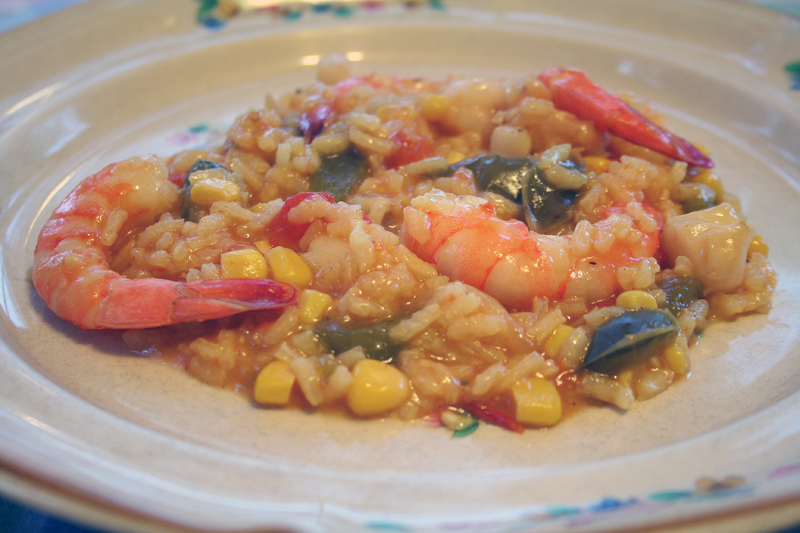
There is something about the aroma of onions and peppers grilling or sautéing in butter or extra virgin olive oil, and it brings back memories of grilled sausage with onions and peppers, which is a staple accompaniment with the ritualistic red beans rice every Monday in New Orleans. The combination of the two just seems like one of those food ingredients matched in heaven. These two ingredients are included in this recipe, which is an adaptation of a “Seafood Paella” recipe from the Weight Watchers cookbook Simple and Classic Home Cooking, and found on page 68 in the Fish & Shellfish section.

Recipe Retool: Once again, this recipe is being adapted to fit more with our own style of cooking, and have made several updates to improve upon the style and complexity, without loosing any of the original flavors. The recipe title is the first change updated to reflect mutually in ingredients and procedures, several ingredient quantities were increased, and the procedures for preparation steps modified as well.
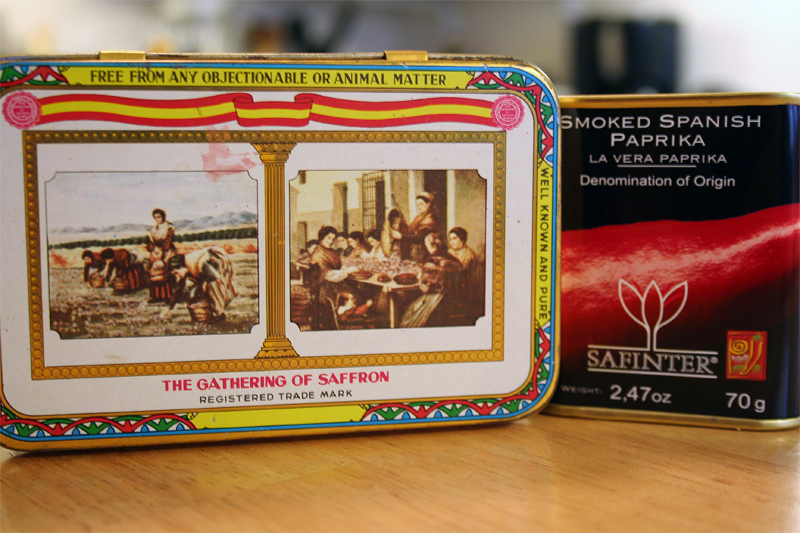

The original recipe named “Seafood Paella” utilizes Arborio rice and is prepared much like a risotto; therefore, as our first update we have added “Risotto” to the recipe title. Thought about removing the “Paella” portion of the title since there is no sausage in the dish, but with the paprika and saffron the name persists.
The original recipe calls for ½ teaspoon of saffron, I have increased the amount to 1 full teaspoon. In addition, smoky paprika replaced the plain paprika in the original recipe and increased from ¼ teaspoon to a full teaspoon.
The onion, bell pepper, and garlic amounts were also increased by the following amounts: onion from 1 cup to 2 cups, and the recipe called for sliced onion, I made them julienne, bell pepper from 1 ¼ cups to 2 cups, and changed the diced to diced on a bias cut, and garlic from 3 cloves to 8 cloves.
The original procedures call for the rice to cook for 1 minute, with the onions, bell pepper, and garlic before adding the stock; we cooked the rice for about 2 minutes or so, stirring well.
The recipe also called for ½ pound of shrimp, we bought 1 pound of shell on shrimp and peeled them with the tail on, so the actual weight was more like ¾ (12-ounces) of a pound.
The original recipe calls for boiling the stock for 10 minutes with the paprika, saffron, and black pepper. I brought these ingredients to a boil, and then simmered on low for the 10 minutes.
I add the garlic to the sauté onions and peppers several minutes later, in the original recipe the garlic is added initially with them. I like to reserve minced garlic for later in the sauté process as it tends to burn if allowed to cook too long.
The original procedure also calls for stirring in the shrimp and scallops with the tomatoes and corn and cooking an additional 10 minutes or until all liquid is absorbed. I omitted the seafood in this step and allowed the tomatoes and corn to cook 10 minutes on their own, then I added the seafood and continue to simmer for another 5 minutes uncovered, this keeps from overcooking the seafood.

Other Considerations: For future reference, some char grilled corn on the cob, then cut the kernels right off and into the saucepan in place of the canned corn would add a completely new flavor and dimension to this dish. In addition, seafood stock in place of the chicken stock would change the flavor profile up a bit.
| Ingredients |
| 6 |
Cups |
Chicken stock |
| 1 |
Tsp |
Saffron threads |
| ¼ |
Tsp |
Fresh cracked black pepper |
| 1 |
Tsp |
Smoky paprika |
| 2 |
Tbsp |
Olive oil |
| 2 |
Cups |
Onions, julienne |
| 2 |
Cups |
Green bell pepper, bias cut diced |
| 8 |
Cloves |
Garlic, minced |
| 1 ½ |
Cups |
Arborio rice |
| 2 |
Cups |
Plum tomatoes, diced |
| 1 |
Can |
Mexican style corn,(11-ounces) |
| 12 |
Ounces |
Shrimp, medium-sized, shelled, tail-on |
| ½ |
Lb. |
Bay scallops |
| Procedure Steps |
| 1. |
Combine the chicken stock, saffron threads, black pepper, and smoky paprika in a 2-quart saucepan. Bring to a boil, and then reduce heat to a low simmer to keep warm. |
| 2. |
Meanwhile, in a large sauté pan add the olive oil over a medium-high heat. Sauté the onions and peppers until tender, and then add the garlic. Stir well to combine as the ingredients cook. |
| 3. |
Add the rice and stir well to incorporate and allow to cook for several minutes. Then slowly stir in the warm stock mixture and reduce heat to simmer, uncovered for 10 minutes. |
| 4. |
Stir in the tomatoes and corn, and continue to simmer another 10 minutes, stirring often. |
| 5. |
Add the shrimp and scallops and stir well, continue to simmer another 5 minutes or until liquid is absorbed, stirring occasionally. |
| 6. |
Turn off heat, cover, and allow to rest for five minutes. |
This recipe yields approximately 8 one-cup servings, and the nutritional values of the original recipe my be altered with the addition of the extra onions, bell peppers, garlic and shrimp: 6 WW points value, 279 calories, 42.4g carbohydrates, 4.6g fat, 1.7g fiber, 16.3g protein, 48mg cholesterol, 673mg sodium, 31mg calcium.
Tags: Recipes · Seafood · Weight Watchers